Tag: Intergenerational Knowledge Transfer

رسیدن دانش، قضاوت و تجربه از نسل قبل به نسل بعد

  • Four Decisions for a “Why”

    Four Decisions for a “Why”

    When an art collection passes from one generation to the next, the new owner inherits more than a few artworks and the papers that prove they own them. They must decide what to keep, how to protect it, when to share it with others, and whether to sell. Knowing an artwork’s price and specifications is not enough to make these decisions. The real question is whether the heir knows why a work entered the family’s collection and what it has meant to the family.

    This Genar article draws on cultural capital theory and the experiences of families who own art collections to outline the four main decisions an heir faces when a collection changes generations. It shows why transferring ownership without transferring knowledge, and the logic behind how the family chose its assets, is not enough. It also shows how the next generation can develop the ability to judge and decide about the collection.

    Ownership can be inherited; judgment has to be learned

    In his essay “The Forms of Capital” (1986; in Handbook of Theory and Research for the Sociology of Education, ed. J. Richardson, Greenwood, pp. 241–258), the French sociologist Pierre Bourdieu describes cultural capital in three forms: lasting dispositions of mind and body, cultural objects such as books and paintings, and formal educational credentials. For our discussion, the difference between the first two matters most. You can hand an artwork to someone else, but ownership alone does not give them the ability to understand and enjoy it. That ability takes time, experience, and personal involvement. We call it “judgment.” It is the part of intellectual capital that helps an heir move from mere owner to steward.

    This difference matters for family art collections. An heir may own a work without knowing why the family bought it, what place it holds in the family’s history, or what should guide decisions about its future. Bourdieu did not write directly about family collections, so applying his framework here is this article’s own interpretation.

    Judgment is built from three questions

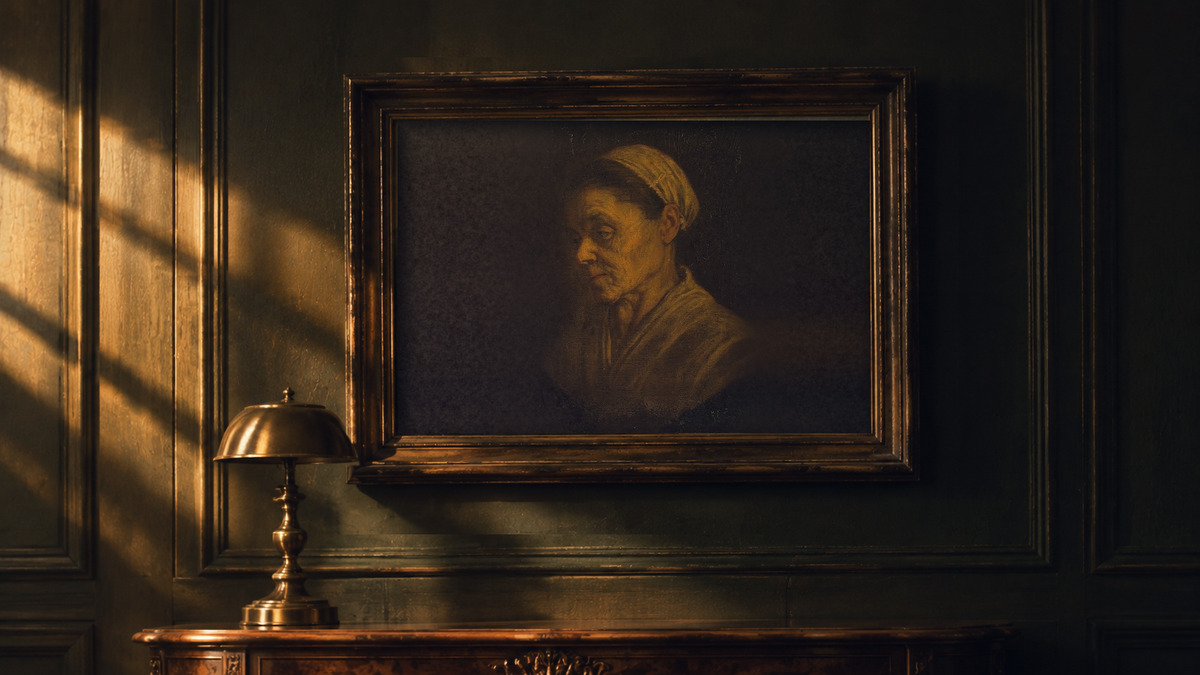
    Picture a painting that hung in your parents’ living room for years and now belongs to you. You know its frame, even the mark its nail left. But you don’t know what it is worth or who bought it, and if someone asked why it stayed in your family, you would have no answer. This situation is neither unusual nor rare.

    According to the Art & Finance Report 2025, the ninth edition of a joint study by Deloitte, the international audit firm, and ArtTactic, a leading firm in art-market research, data analysis, and advisory, about 61% of collectors have never discussed their collection with their heirs. Another 21% have made only informal references to it. In other words, the future owners of these works are unaware and unprepared. To decide about an artwork, an heir must be able to answer three questions:

    • Who owned the work, what is its history, and how well is its authenticity confirmed?
    • What are its market value and its insurance value?
    • Who chose it, and what place does it hold in the family’s history and life?

    Experts and appraisers can answer the first two. The third depends on the family’s own knowledge and narrative, and it underlies all four of the heir’s main decisions about the collection.
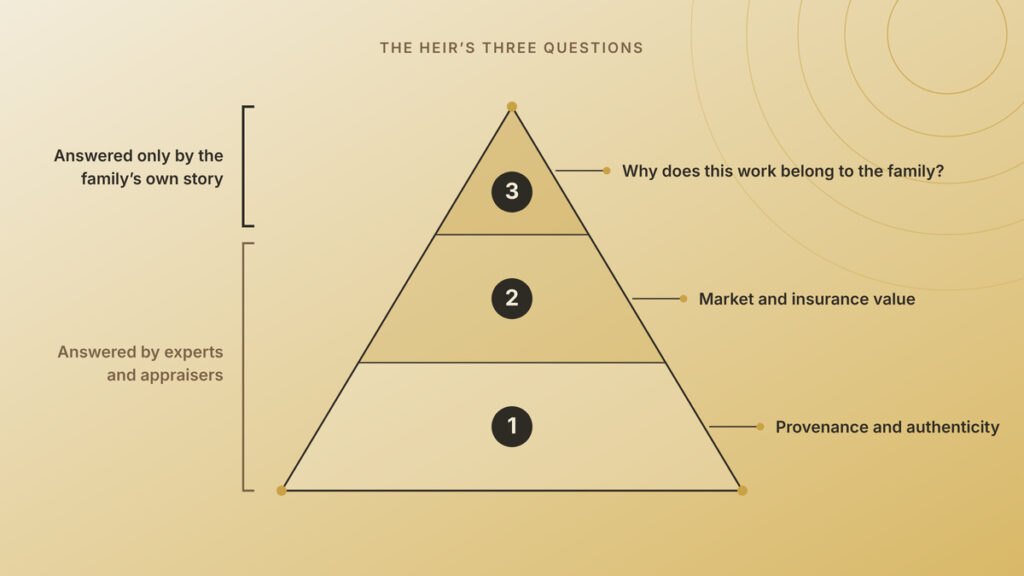
    A three-tier pyramid of the questions an heir faces about an artwork: provenance and authenticity, market and insurance value, and why the work belongs to the family. Experts answer the lower two; only the family’s own story answers the top one.
    Experts and appraisers can answer the first two questions, but the third depends on the family’s own understanding and narrative.

    The false assumption of automatic knowledge transfer

    Many people wrongly assume that a child who grew up beside the family’s artworks has naturally acquired the necessary understanding. Bourdieu also points to the family environment’s role in the implicit transmission of cultural capital. Even so, having a work in your surroundings does not necessarily mean you know why the family chose and kept it.

    This assumption is especially fragile when the heir grew up far from the family’s home or country, or when the work has been separated from the context that gave it meaning. In such cases, the heir may know the work yet remain unaware of the memories, conversations, and values behind its selection.

    This article suggests that part of the families’ silence in the Deloitte survey may come from this very belief: that the necessary understanding passes on by itself. This is an interpretation, not a direct finding of the survey.

    Three logics behind an art collection

    When we ask “why is it here?”, we don’t mean one reason alone. A collection can take shape for at least three kinds of reasons, and families usually pursue a mix of them. Each of the three families below illustrates one of these reasons especially clearly.
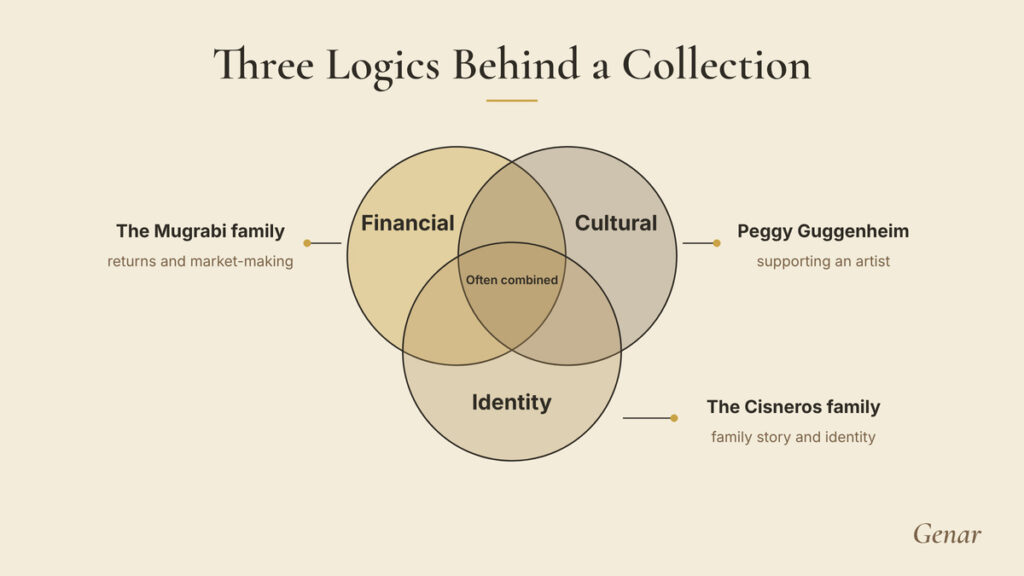
    A three-circle Venn diagram of the financial, cultural and identity logics behind art collections, illustrated by the Mugrabi family, Peggy Guggenheim and the Cisneros family. Families usually follow a mix of the three.
    There are at least three kinds of reasons for forming an art collection, and families usually pursue a combination of them.

    The financial reason: the Mugrabi family

    In 1987, at Art Basel, José Mugrabi, a textile trader who had spent his youth in Colombia, saw Andy Warhol’s paintings for the first time. By his own account, he felt something in these works that he had not felt in other art. Yet a 2014 account describes the family’s approach as openly financial. He and his sons, Alberto and David, held the largest collection of Warhol’s work outside the Andy Warhol Museum in Pittsburgh.

    Alberto called them “market makers,” because to influence the prices of an artist’s work, you have to hold a substantial number of that artist’s pieces. They took part in roughly fifty auctions a year. Nearly every work in their collection was for sale, and the family had no plans to build a museum for them (Don Thompson, The Supermodel and the Brillo Box, Palgrave Macmillan, 2014).

    The two generations’ tastes also differed: José liked Pop Art, while his sons favored younger artists such as Damien Hirst and Jeff Koons. Even so, the difference did not stop them from working together. When a collection rests on financial logic, aligned tastes are not necessary. The Mugrabis are, of course, an exceptional case. They operated with a very large inventory and a vast amount of buying and selling, which most heirs could not replicate.

    The cultural reason: Peggy Guggenheim

    In 1943, Jackson Pollock was a thirty-one-year-old painter working as a guard and preparator at the Museum of Non-Objective Painting, Solomon Guggenheim’s museum of abstract art. Peggy Guggenheim, Solomon’s niece, offered Pollock a contract with a monthly stipend so he could paint full time. She also commissioned a large mural from him for the entrance of her home (Guggenheim Museum, exhibition statement for Away from the Easel: Jackson Pollock’s Mural, October 2020). In 1951, she donated that same work to the University of Iowa.

    This is an example of the cultural reason a collection takes shape: supporting an artist early in his career. Two Guggenheims, two institutions, two different views of one artist.

    The identity reason: the Cisneros family

    From the 1970s, Patricia Phelps de Cisneros and her husband, Gustavo, built a collection of Latin American art, with roots in their homes in Caracas and New York. The collection’s stated mission is to increase understanding and appreciation of the diversity and complexity of Latin American art.

    In 2016, the family donated more than a hundred modern works to the Museum of Modern Art (MoMA) in New York, along with funding for a research center. In 2018, it divided more than two hundred further works among six museums in Latin America, the United States, and Europe. The collection itself described this as part of a long-term, global initiative by the Cisneros Phelps family (Andrew R. Chow, New York Times, 2018). The collection tells a story of the family’s identity: where we came from, and what we want others to see in it.

    What separates these three kinds of reasons is how easily each can be expressed and recorded. A financial reason can be measured in numbers and performance. The other two have to show themselves through narrative, mission, or the family’s behavior. Peggy Guggenheim and the Cisneros family recorded the reasons for their choices in visible acts: a contract, a declared mission, a series of donations. As a result, their heirs can know these reasons rather than guess them.

    The logic of keeping an art collection

    The painting is still in the living room, and the first question seems simple: keep it or sell it? Before answering, remember that keeping, despite appearances, is not a cost-free decision. The work needs suitable space, controlled light and humidity, insurance, and specialist care. Not deciding is also a form of keeping, except that no one has chosen it consciously. The core question is: why should the family keep this work?

    The financial return of art, and its limits

    If the answer is only financial, it is not a strong one. Three finance researchers, Arthur Korteweg, Roman Kräussl, and Patrick Verwijmeren, studied the prices of paintings that sold more than once over several decades. In their paper “Does It Pay to Invest in Art? A Selection-Corrected Returns Perspective” (Review of Financial Studies, 2016), they showed that common art price indices overestimate true returns. Works whose prices have risen get resold more often, so they carry more weight in market data. Put simply, these indices mostly see the winners.
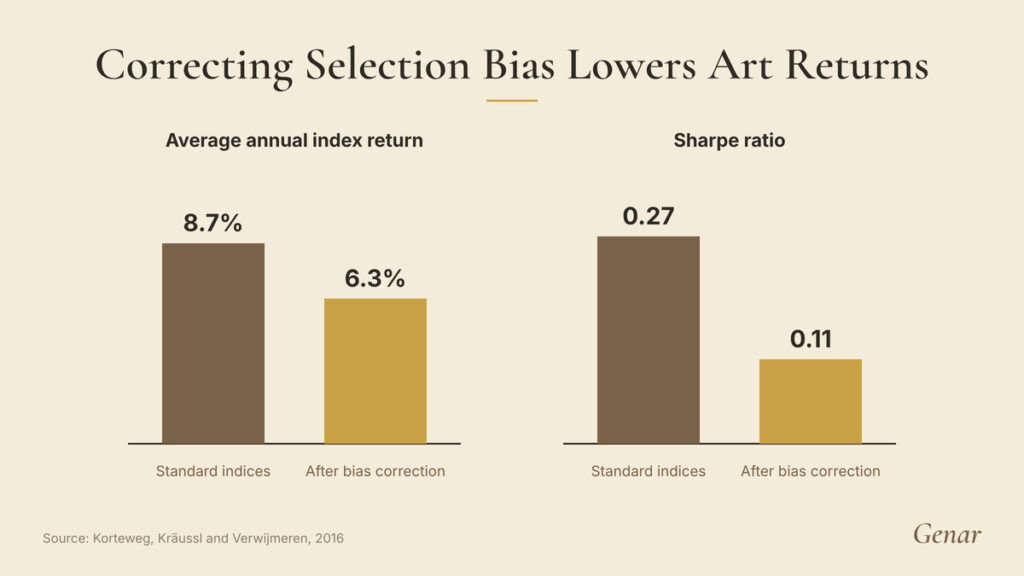
    Bar chart: after correcting for selection bias, the average annual painting-index return falls from 8.7% to 6.3% and the Sharpe ratio from 0.27 to 0.11. Source: Korteweg, Kräussl and Verwijmeren, 2016.
    Put simply, these indices mostly see the winners.

    Once this bias is corrected, investing in a diversified portfolio of paintings looks far less attractive, though deliberately choosing particular styles or artists can still create value.

    The 2025 Deloitte report strikes a similarly cautious note: the case for art as a standalone investment is more open to doubt than before, although art may help preserve capital and hedge against inflation. So the notion that “an artwork always gets more expensive” has no firm foundation. That does not make art worthless. It shows that the reason to keep a work need not be its financial return.

    Non-financial values in preserving family collections

    To answer this, we can draw on research into family firms. In “Socioemotional Wealth and Business Risks in Family-Controlled Firms: Evidence from Spanish Olive Oil Mills” (Administrative Science Quarterly, 2007), Gómez-Mejía and his colleagues showed that families are sometimes willing to accept greater financial risk to preserve family control and identity. They called these non-financial aspects “socioemotional wealth”: the emotional, identity-related, and social values tied to family ownership. We explore this research further in the Genar article “Wealth Transfer Is Not Just Money Transfer.”

    This research concerns family firms, not art collections. Still, an important point follows. A family that keeps a work despite a modest financial return is probably paying for something that matters to it beyond the price. That something may be part of the family’s identity, memory, or cultural heritage. When no one has stated such a reason, the cost of keeping may gradually start to look like wasted resources, and anything whose why is unclear is more vulnerable to a decision to sell.

    This matters even more for the next generation. In Deloitte’s 2025 survey, financial motives matter less to next-generation collectors than to earlier ones, while identity, legacy, and cultural impact stand out. An heir who doesn’t see financial return as reason enough to keep a work needs another reason. If the previous generation hasn’t passed one on, the heir must discover or rebuild it.

    Valuing and insuring an art collection

    Suppose the family has decided to keep a painting. One of the first steps is to take out an art insurance policy, and a policy needs a specific figure. But relying only on auction prices can lead to insuring a work for less or more than its true value. Moreover, 63% of collectors have little trust in art-market data (Deloitte, 2025). Two different questions arise here:

    • What is the work worth?
    • What is it worth to the family?

    The first concerns financial valuation. Market prices cannot answer the second. When no one has recorded why the collection formed, price becomes the only yardstick available to heirs, and given the art market’s limited transparency, it is not always reliable.

    Randall Willette, an art-collection advisor, points to the consequences of families lacking clear rules in “Establishing Sound Governance for a Family Art Collection” (WealthBriefing, February 19, 2013). In such conditions, families may make decisions ad hoc and without enough consultation, and emotions that weigh too heavily can later bring challenges.

    Picture two siblings who disagree about a painting. One wants to keep it, and the other prefers to sell. If the only information they share is price, the dispute narrows to arguing over numbers. Which appraiser? Which auction? The price from which year? Meanwhile, the central question, the work’s place in the family’s history, goes unanswered.

    Lending and donating: the collection’s role in public space

    Suppose a museum asks to borrow a painting from the family collection for a few months for an exhibition. The family can lend the work or, if it wishes, donate it to a cultural institution. This is the first decision that takes the collection beyond the family’s private sphere and involves others.

    At this stage, the work’s provenance becomes more important. Who held the work and how it changed hands help confirm its authenticity and credibility, and they also clarify its historical significance (Randall Willette, 2013). But the more important question is: what is this work meant to say to others?

    According to the Deloitte survey, only a limited share of collectors intend to donate their works to public museums. Younger collectors, however, show growing interest in philanthropy through art. This shift highlights the role of next-generation motives in decisions about the collection’s future.

    An heir may want to place a work with an institution whose mission or values match their own, even if that choice differs from the original owner’s motive. That difference is not necessarily a problem, because the next generation is not meant to continue every earlier decision unchanged. The problem begins when the heir does not know why the collection formed. In that situation, the change of course comes from not understanding the legacy rather than from knowing it.

    Selling, and the logic of leaving a collection

    Unlike keeping or lending, selling is usually a decision you cannot reverse. Even so, selling an artwork does not necessarily mean failing to preserve the family’s legacy. Sometimes shifting priorities, a need for liquidity, or a change in how the family sees the collection makes selling a reasonable decision.

    The Deloitte report also points to the art market’s limitations, including low transparency, limited liquidity, and the difficulty of assessing prices. In such a market, an attractive offer alone is not enough to decide. Besides price, the heir must be able to assess the work’s place in the collection and the reason the family kept it.

    Two heirs may sell a work at the same price for entirely different reasons. The first knows why the work entered the collection and has concluded that this reason no longer holds as it once did, so selling reflects an informed assessment. The second knows nothing of the work’s background or its place in the family and sells simply because a good offer arrived. The outward result is the same in both cases, but only the first heir decided based on understanding.

    The point is not that the heir must keep every work. It is that they can explain why they keep or sell it. Even keeping a work out of habit alone, without understanding its place in the collection, can be as unfounded a decision as a hasty sale.

    Four decisions and one shared logic

    Keeping, valuing, lending or donating, and selling are not four independent decisions. Each rests on the understanding the heir has gained of the work and its place in the collection. If that understanding is missing, its weakness shows at every stage of decision-making.
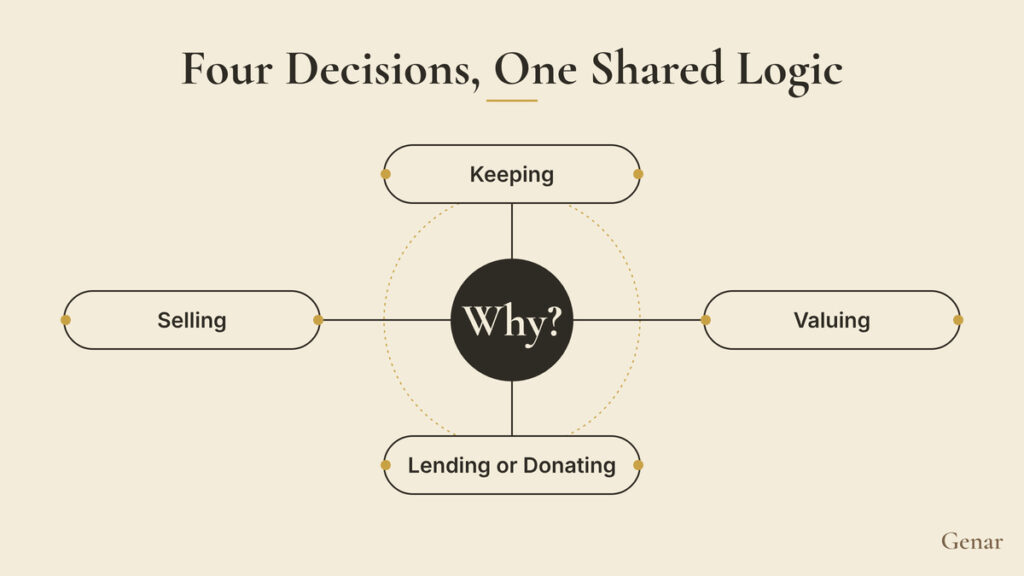
    A diagram of four decisions, keeping, valuing, lending or donating, and selling, all arranged around the central question “Why?”
    Keeping, valuation, lending or donating, and selling are not four independent decisions. Each rests on the understanding the heir has gained of the work and its place in the collection.

    Passing on the why is not meant to oblige the next generation to repeat past decisions. This understanding should let the heir evaluate earlier decisions, change them when necessary, and take responsibility for their own choices.

    The difference between ownership and stewardship becomes clear here: ownership gives a person the right to decide, but understanding the collection’s logic lets them exercise that right knowingly.

    The Rockefeller family and MoMA: passing on the why through responsibility

    The Rockefeller family’s story with the Museum of Modern Art (MoMA) in New York shows how passing on a collection’s logic connects to the next generation’s real involvement. In 1929, Abby Aldrich Rockefeller, wife of John D. Rockefeller Jr., founded MoMA together with two friends, Lillie P. Bliss and Mary Quinn Sullivan.

    Abby’s interest in modern art differed from her husband’s taste. Junior was more drawn to sculpture, architecture, and old European crafts, and he created a separate institution to support those fields. This difference shows that even within one family, collections can form according to different logics and interests. (Rockefeller Archive Center; Abby Aldrich Rockefeller and Modern Art; Suzanne Loebl, America’s Medicis: The Rockefellers and Their Astonishing Cultural Legacy, 2010)

    In 1935, Abby donated about 181 paintings and drawings, nearly all of her modern art collection, to MoMA. Her other collections also went to institutions suited to their nature and the context in which they formed. Sculpture and decorative arts went to The Metropolitan Museum of Art and The Cloisters, Japanese prints to the Rhode Island School of Design, and her American folk art collection to Colonial Williamsburg. Financial value alone did not decide where a work went; the type and cultural standing of each collection mattered too. (Rockefeller Archive Center; Abby Aldrich Rockefeller, 1874–1948)

    The next generation’s role also went beyond receiving assets. Nelson Rockefeller became president of MoMA in 1939, ten years after the museum’s founding. David Rockefeller, the family’s younger son, joined the museum’s board of trustees in 1948 and later chaired it. David had known art since childhood but was at first skeptical of contemporary art. Alfred H. Barr Jr., MoMA’s first director, introduced him to contemporary artists and movements. (ARTnews, 2017; Helen Stoilas, The Art Newspaper, March 20, 2017)

    This experience matters for intergenerational transfer in three ways. The family entrusted the logic behind the collection to an institution with a clear mission. The next generation took on real responsibility in running that institution. And becoming familiar with the previous generation’s outlook did not mean repeating it unquestioningly. David could be skeptical of contemporary art, yet his position let him learn, examine, and form an independent judgment.

    The Rockefellers’ experience cannot serve as a general template for all families. The scale of their wealth, their access to cultural institutions, and their historical circumstances were exceptional. Even so, the example shows that an art collection’s legacy transfers more deeply when understanding and responsibility reach the next generation alongside ownership.

    How knowledge and responsibility pass within the family

    Art advisors, appraisers, insurers, and lawyers can play an important role in managing an art collection. They provide specialist information on authenticity, financial value, storage conditions, and legal requirements. But this information alone does not tell the heir why the family chose a work or what role it was meant to play. That understanding has to form within the family and pass on there.

    Families should not put this process off until ownership transfers. If the heir first meets the collection after the owner’s passing, or when the family divides its assets, they will have limited opportunity to learn its history and the logic of past decisions. Knowledge and responsibility should begin passing on earlier and enter the next generation’s experience gradually. Three steps can help.

    Record and explain the logic behind the choice of works

    The current owner should be able to explain why they bought, kept, or valued each work. This doesn’t require a detailed written history. Sometimes it is enough to know why someone chose a work, how it related to the family’s values, or why the family preserved it over the years, and that gives the heir decisive information. Recording this matters most before memories and details fade.

    Involve the heir gradually in decisions

    Theoretical familiarity with the collection is not enough to develop judgment. Before ownership fully transfers, the heir should take part in real but limited decisions. For instance, they might give their view on buying a new work, choosing where to keep a piece, lending a work to an exhibition, or allocating a maintenance budget. This lets them see the consequences of their choices and gradually take on more responsibility.

    Write the family’s art collection policy

    The family can prepare a written document that sets out the collection’s purpose and the principles for deciding about it. It should answer questions such as why the family keeps the works, what criteria guide acquisitions, under what conditions it would sell, how it will transfer or donate works, and what each family member is responsible for. The process has value beyond the final document: the conversation and agreement needed to produce it help clarify how the generations’ views differ.

    These steps are not meant to impose the current owner’s taste and decisions on the next generation forever. The aim is for the heir to understand the collection’s logic first, then decide whether to continue, adjust, or set it aside. In the end, the quality of an art legacy’s transfer depends not only on ownership documents but also on how ready the next generation is to accept responsibility and exercise independent judgment.

    Exercise: the column missing from the provenance

    An artwork’s provenance usually records the year a given person or institution held the work and how it passed from one owner to another. This information matters for verifying authenticity and credibility, but it usually doesn’t explain why someone chose or kept the work.

    To test how much that matters, choose a specific work from the family collection and write out its provenance as a table. Then add a column titled “Why?” and record the reason the family bought, kept, or transferred the work.
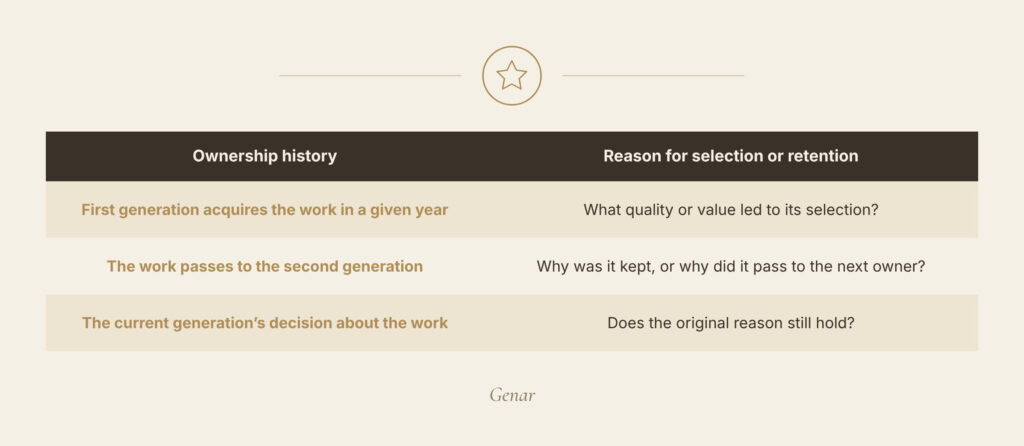
    A two-column table with three rows of an artwork’s ownership history and, beside each, the question of why it was chosen or kept.
    To test the importance of this information, you can choose a specific work from the family collection and write out its provenance in a table.


    Next, ask the next generation of the family to write down, without consulting the current owner’s explanations, their own sense of why the work is in the collection. Comparing the two accounts can show how much of the collection’s founding logic has passed on and which parts remain unspoken.

    This exercise is not meant to judge past decisions as right or wrong. Its aim is to show the gap between knowing why a work belongs to the family and understanding why that same work has become part of the family’s art legacy.

    From ownership to responsibility

    This issue is not limited to the transfer of art collections. Other Genar articles have repeatedly noted that in intergenerational wealth transfer, assets may pass from one generation to the next, but the ability to manage, preserve, and grow them does not pass on automatically. That ability requires understanding, experience, and the next generation’s gradual involvement.

     

  • Wealth That Doesn’t Show Up in Financial Reports

    Wealth That Doesn’t Show Up in Financial Reports

    In years of crisis, intergenerational wealth transfer is more than moving assets. It answers one question: after all these years, does the heir still see the family’s wealth as their own?

    At the end of the film A Separation, Termeh must choose between her father and her mother. We see her in a home where three generations live under one roof: a grandfather who belongs to the first generation and can no longer move on his own, a middle generation torn between staying and leaving, and a third generation that has to choose. The film ends before we hear Termeh’s answer. The same scene plays out in families that own a business: the first generation built, the second hesitates between staying and leaving, and the next generation, without realizing it, is building a world of its own.

    Crises slowly open distances between generations: a distance of geography, a distance of experience, and a distance of language.

    This Genar article examines all three distances and offers ways to close them. At the end, you will find a quiz with a few questions you can raise at the family dinner table this week.

    What Is a Family’s Real Wealth?

    When people talk about family wealth, they usually mean financial statements and assets such as property, shares, and cash. But James Hughes (Family Wealth: Keeping It in the Family, Bloomberg Press, 2004), who has worked with multigenerational wealthy families for three decades, defines it differently. In his view, a family’s real wealth is the human, intellectual, and social capital of its members. Financial capital is not the goal here; it is a tool for growing those three forms of capital. This definition matters especially for wealthy Iranian families who have lived under the pressure of crisis in recent years, because it shows that the main danger does not always lie in the market.

    The Family’s Three Forms of Capital: Human, Intellectual and Social

    Social capital is the family’s network of relationships: the people who have worked with the family for years, the trust of a market and an industry that took years to earn, and a name, or more precisely the good reputation, that opens every door. No one builds this capital overnight, and no one inherits it from a distance.

    Intellectual capital is the knowledge and judgment that preserve and grow wealth: knowing where the wealth came from, the ability to make decisions under pressure and a horizon that sees ten years ahead. This is what turns an heir from an “owner” into a “steward.”

    Human capital is the family members’ ability to stay together: trust, dialogue between generations, and each person’s readiness for the responsibility entrusted to them. The other two forms of capital stand on this foundation.

    The important point is that none of these three forms of capital appears in the financial statements. A family can be financially healthy and, at the same time, be losing all three.

    How Do Crises Create Gaps?

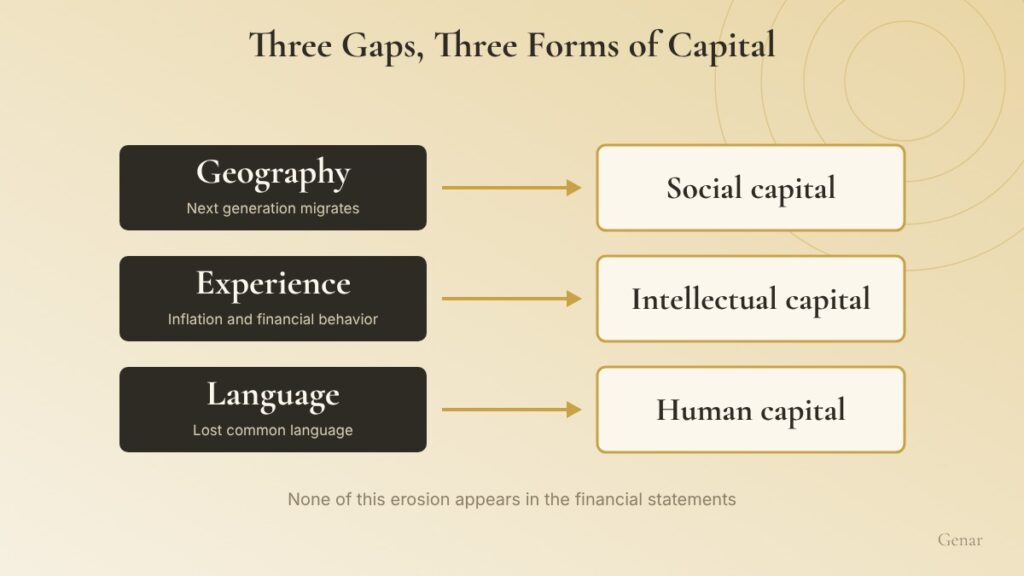
    Crises are usually measured in the language of assets: a falling rial, market volatility, sanctions. But their more hidden effect changes the heir’s relationship with wealth. Migration, chronic inflation, and changing lifestyles pull the new generation away from the family’s wealth, and each distance erodes one of the three forms of capital.

    Diagram of three rows: geography (migration of the next generation) leads to social capital, experience (inflation and financial behavior) to intellectual capital, and language (a language gap) to human capital, on a cream-to-gold gradient background
    Each distance erodes one of the family’s three forms of capital, and no financial statement records it.

    This erosion is slow; it does not show up in any financial report or get recorded in any month of the year. Yet trust has worn thin, or the heir no longer knows where the wealth came from. That is why preparing heirs must begin before financial warning signs appear and must be part of a family financial culture to which every generation contributes.

    Geography: Heirs’ Migration and the Erosion of Social Capital

    The migration of heirs is the first and most visible gap in social capital, the relationships and trust on which family wealth stands. Families usually prepare for someone’s absence before that person even leaves. Decisions start being made without them, and the person gradually adapts to this as well.

    Migration Among Entrepreneurs and Senior Managers

    If you think this is a story about young people with nothing to lose, the numbers say otherwise. In the survey of the Iran Migration Yearbook 1401 (2022–23), the desire to emigrate among entrepreneurs and senior managers was higher than in most groups, reaching about 70 percent. Those who have the most capital to manage think most about leaving.

    Leaving is usually one-way, too. In the same yearbook, 62 percent of Iranian emigrants had firmly decided not to return, and only 14 percent were certain they would go back. These figures predate the war, the heavy sanctions and the blockade.

    For an ordinary family, migration means leaving. For a family whose wealth is rooted in this soil, it means being split in two. But what suffers most are the relationships built over decades: the market’s trust and the credibility that opens the way to every deal. None of it fits in a suitcase, and none of it can be inherited from a distance.

    A Distant Heir or an Absent Heir?

    An heir can become absent without migrating. Someone who receives the reports and only skims them will one day own something they never had a role in running. This absence happens without a single flight.

    On the other hand, a member of the next generation who lives outside Iran can also be the family’s greatest asset: someone who has tested themselves and their skills outside the shadow of the family name and sees beyond the usual routine of the family business. The experience of one generation of the Grant family illustrates this well. The difference between these two heirs is not geography. It is the answer to one question: can this heir be trusted with a real decision and the responsibility that comes with it?

    Responsibility Instead of Video Calls

    When an heir to a family business emigrates, the usual response is to keep minimal contact: a weekly call, sending reports and passing on major news. This contact is valuable, but it does not close the gap, because the heir is only a listener. They know what happened, but nothing depended on their decision. People become attached to things whose outcomes depend on them, not to things they are merely informed about.

    Social capital works the same way. The family’s network (partners, suppliers, bankers and long-serving managers) does not survive on names alone; its continuity depends on decisions and accountability.

    If this network knows the heir only as “So-and-so’s son or daughter who lives abroad,” it sees them only as a name from the past. If it sees them as someone who has made a decision on a matter and taken responsibility for it, it sees a person it can work with in the future.

    What Makes Responsibility Real?

    Responsibility that exists only on paper is empty, and the heir quickly realizes it. For responsibility to be real, four conditions are needed:

    • Real decision-making: The heir does not give an opinion; they make the decision. If the elders always have the final word, the heir realizes their opinion was a formality.
    • Tangible results: The decision must produce a result that can be measured, whether it turns out good or bad. Responsibility that is never evaluated is practice, not responsibility.
    • A defined domain: The area that belongs to the heir must have clear boundaries. “Keep an eye on everything” gives no one responsibility, but “This part is yours” gives a person practical responsibility.
    • A regular schedule: Reviews at fixed intervals, for example, at the end of each quarter. Scattered decisions do not build a relationship; they create an irregular rhythm.

    Inflation, the Young Generation’s Experience and the Erosion of Intellectual Capital

    The second gap is not created by geography; it comes from experience. Two generations can sit in the same house and eat together, yet each has lived through the crises differently. This difference stems directly from intellectual capital: from how the heir sees wealth, what horizon they set for it, and what they rely on at the moment of decision.

    Experience Teaches; It Does Not Preach

    Most families begin preparing heirs with talk: about thrift, honesty, the hardship of building. But an heir learns less from what they hear than from what they live through.

    In A Separation, Termeh tips the gas station attendant, and Nader asks her to get the money back. Reluctantly, Termeh gets out of the car, argues with the man, and takes the money back, and Nader smiles and tells her to keep it. Her father gave her no lesson about right and wrong; she learned it with real money, a real person, and a little real fear. The film also shows the bitter side of this experience: Termeh, who learned honesty from her father’s words, lies to the judge at the end to protect him, because she learned concealment from his actions.

    This is not merely an observation about parenting. Ulrike Malmendier and Stefan Nagel, two leading economists, showed in “Learning from Inflation Experiences” (Quarterly Journal of Economics, 2016) that people give too much weight to the inflation they have experienced themselves and build their financial decisions on it. The effect is stronger among younger people, because recent experience makes up a larger share of their lives. Put simply, each generation understands money through the crisis it has seen, not through what it has been told.

    A Generation That Has Seen Only Inflation

    Imagine someone who is 25 today and has seen nothing but inflation. Since the Iranian year 1398 (2019–20), annual inflation has not fallen below 30 percent in a single year: from 34.8 percent that year to 45.8 percent in 1401 (2022–23), and in August 2026, point-to-point inflation reached 89 percent. Their entire adult life has taught one lesson: money does not last, and it should be turned into another asset quickly.

    An ISPA survey in Mehr 1402 (fall 2023) showed the same pattern across Iranian society. People over 50 preferred bank deposits more than others, those aged 30 to 49 favored land and housing, and young people leaned toward gold and coins. Three generations, three logics for the same money, and each logic comes from crises that generation lived through firsthand.

    For most families, this is only a question of preserving asset value. But in a family that built its wealth, a larger issue weighs heavily: what is at risk is intellectual capital, that is, judgment, horizon, and the ability to see ten years ahead.

    An heir who has seen only inflation may be right to prefer trading over building. Under these conditions, if they see the family’s wealth as something to be traded rather than something that was built, the long-term view that preserves wealth slowly fades.

    The Founder’s Behavior in Crisis: A Lesson Plan for the Heir

    Here we must look at the other side of the issue: in these years, what has the founder done in the face of crisis? If the heir has watched the elders move capital into gold and foreign currency at every piece of bad news, that is where today’s lesson came from, not from advice at the dinner table. But if they have seen part of the profits reinvested in the business during the hardest years, the lesson they learned will be entirely different.

    Neither behavior is necessarily wrong; avoiding risk in a crisis is sometimes the wisest choice. The point is that the heir sees the behavior but does not understand the logic behind it unless someone explains it. So the founder’s behavior in crisis needs to become more deliberate, and the reasoning behind it needs to be shared with the heir.

    How Can We Give the Heir Real Decision-Making Experience?

    Building cannot be taught through advice alone; its experience can only be passed on, as in the gas station scene in A Separation. For families that own a business, this means a small but real investment decision with four features:

    • Real money: The amount can be small, but it must be real money, not a simulation. When the heir knows a mistake has a cost, they think differently.
    • A long horizon: The decision’s outcome should unfold over years, not weeks. The goal is for an heir who has made only short-term decisions to also experience the fruits of patience.
    • Shared review of results: Every few months, the older and younger generations should review the outcomes of decisions and the reasons behind them.
    • Reviewing earlier generations’ mistakes: When the founder talks about their own wrong decisions, the heir understands that making mistakes is part of building.

    The Lost Common Language and the Erosion of Human Capital

    The third gap is the quietest of all. In many families, two generations live side by side for years without understanding each other, and this erodes the family’s human capital: the gradual fading of trust, dialogue, and readiness to take on responsibility.

    In A Separation, Termeh is doing her Persian homework. The teacher has included an Arabic word in the list, and Nader insists that his daughter write its Persian equivalent, even if it costs her marks. The daughter is caught between her teacher and her father. Much the same happens at the dinner tables of business-owning families.

    The 70 Percent Rule: Fact or Myth?

    You have probably heard that 70 percent of fortunes are lost by the second generation. The number is repeated so often that few people have asked where it comes from.

    Researchers such as James Grubman (International Family Offices Journal, 2022) traced its origin and arrived at a study by John Ward (Keeping the Family Business Healthy, Jossey-Bass, 1987) that examined 200 family-owned manufacturing businesses in one U.S. state. But 70 percent did not show lost wealth either; it showed only that ownership of the business had not stayed in the family.

    So the number can be set aside, but the problem remains. The question is not what percentage fail; it is where failure begins and why.

    Wealth Is Lost at the Dinner Table

    The researchers who made the number famous also report a more important finding. Williams and Preisser (Preparing Heirs, Robert Reed Publishers, 2003) examined why transitions failed, although the raw data behind their research was never published. In 60 percent of cases, communication and trust within the family had broken down, and in 25 percent, heirs had not been prepared to take on responsibility. In other words, most fortunes are not lost in the market; their undoing is decided at the dinner table.

    The picture is the same in our neighborhood. In 2024, PricewaterhouseCoopers (PwC), one of the world’s four largest audit and advisory firms, surveyed the next generation of Dubai’s family businesses (NextGen Survey, Dubai edition). Half of them said one of the hardest parts of succession is that the current generation cannot or will not step back. Only 39 percent were sure their family had a succession plan. So in most families, succession in the family business is still not a plan; it is a conversation that keeps being postponed.

    A Values Gap or a Language Gap?

    This situation is usually called a values gap or a generation gap in business-owning families. But much of it is, at heart, a language gap.

    The founder built the business in a time of scarcity and relied on people; a contract was simply a handshake. The heir grew up with sanctions on one side and the internet on the other, and relies on data. Both want the business to endure; they simply talk about it in two different languages, and each assumes the other thinks the wrong way. Trust slowly declines, and with it, the readiness to take on responsibility.

    Reverse Mentoring: When Both Generations Are Teachers

    This problem has an old solution. In 1999, Jack Welch asked young employees at General Electric to teach senior executives how to use the internet. The practice later became known as “reverse mentoring,” and researchers such as Murphy (“Reverse Mentoring at Work,” Human Resource Management, 2012) studied its effect on learning across generations.

    Learning can be two-way in families too. The new generation teaches something real, from new tools to artificial intelligence and data analysis, that adds something new to the business. The older generation teaches negotiation, reading people, and making decisions under pressure, backed by more than 40 years of experience, not just a few books.

    For this relationship to work in practice, it needs a few features:

    • It must be real.
    • It must be regular.
    • The learning side must genuinely ask questions.
    • The results must be put to use.

    When both generations teach each other, neither remains a stranger to the other, and the questions that were always postponed (such as succession and handing over responsibility) begin to feel more like real, comfortable conversations.

    Three Gaps, One Chain

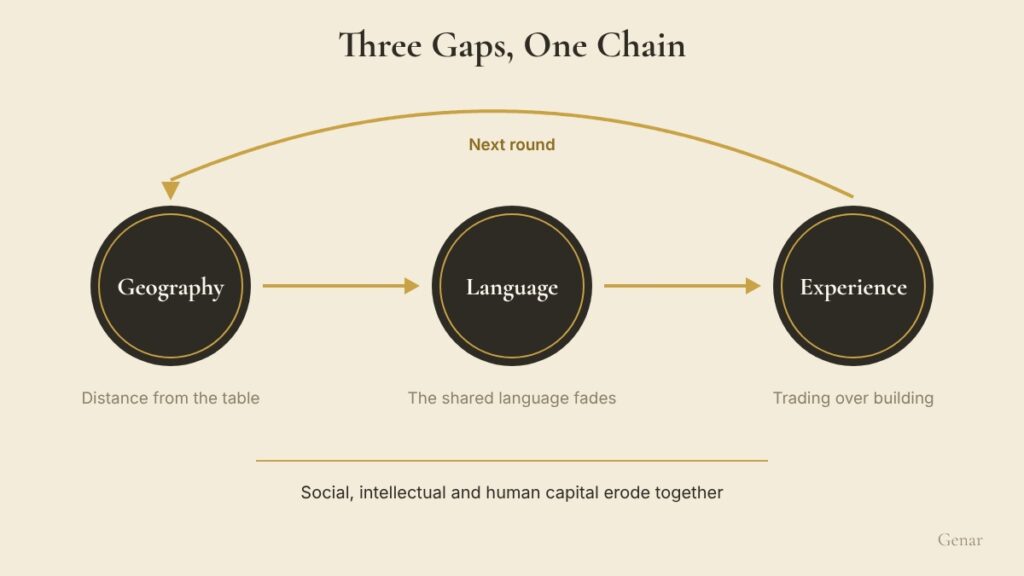
    These three gaps do not work in isolation. Each deepens the others, which is why the erosion of capital is often noticed late.

    Diagram of three circles linked by arrows: geography, language and experience, with a return arrow from the last to the first marking the next round
    The gaps do not work in isolation: distance fades the shared language, a lost language pulls the heir toward transactions, and the next round begins from there.

    Why Do These Three Forms of Erosion Happen Together?

    The chain can start from any link, but it usually unfolds like this: an heir who has moved away gradually understands less of the previous generation’s language. They are no longer at the table and do not see discussions and decisions up close. An heir who does not understand the language takes refuge in what is familiar: numbers and transactions. They see wealth as something to move and cash out, not something to keep. An heir who knows only transactions sees no reason to continue the business, and if profit is all that matters, it can be found anywhere.

    This is where the next round begins: the next generation drifts further away, the previous generation’s language becomes stranger and relationships fade. Social, intellectual, and human capital erode together, even while the financial statements still look good. That apparent health is exactly why no one hears the alarm.

    The Family Compact

    James E. Hughes Jr. says that to preserve its wealth, a family needs a shared compact: a clear agreement on why its members stay together, what the wealth is for, and what responsibility each person has toward it. More importantly, this compact is not inherited. Each generation must accept it anew. A compact made by the previous generation is only a memory until the next generation embraces it.

    Crises are the moments when such a compact is either renewed or abandoned. A family whose members sit together in the hardest years and ask, “Why are we still together?” renews its compact. A family that simply waits for things to improve has abandoned its compact, and nothing seems to happen until the day the heir says there is no place left for them. The next section is a quiz that shows where your family stands on this path right now.

    The Dinner Table Quiz: Where Your Family’s Heirs Stand

    Ask these nine questions at the family table this week. Answer each one for a specific heir, and if you have several heirs, repeat the quiz for each of them separately. Score each question: zero (no), one (partly), or two (yes).

    Social Capital (First Gap)

    1. Has the heir made at least one real decision about the family’s assets or business in the past six months?
    2. Do key people in the family’s network, such as partners and suppliers, know the heir by name?
    3. Does the heir have a reason other than emotion to stay involved with the family’s wealth?

    Intellectual Capital (Second Gap)

    1. Can the heir explain, in their own words, where the family’s wealth came from?
    2. Have they ever made a decision whose outcome took more than a year to unfold?
    3. In recent crises, has what they saw in the elders’ behavior been more building than fleeing?

    Human Capital (Third Gap)

    1. When did the older generation last learn something from them? (Within the past six months: 2; within the past year: 1; longer ago or never: 0)
    2. Has succession actually been discussed, rather than remaining in one person’s mind?
    • If the main decision-maker were unable to make decisions, would anyone know what to do?

    Scoring and Interpretation

    Add up the scores (maximum 18):

    • Below 6: The gaps are making decisions for you. Start preparing your heirs now.
    • 6 to 12: The gaps exist, but they are still in your hands. A little deliberate attention is enough.
    • Above 12: The family is consciously shaping its heir.

    Each section has a maximum of 6 points. The section with the lowest score shows which gap to start with. The total may look good while one form of capital is almost empty.

    One suggestion: have the older generation and the heir each complete the quiz separately, without seeing each other’s answers, and then compare the results. Where the scores differ is usually where the two generations do not understand each other’s language.

    From Stewardship as a Concept to Stewardship as an Experience

    In the final scene of A Separation, Termeh asks her parents to wait outside. The two of them stand apart in the courthouse corridor, behind a closed door, waiting for an answer they themselves spent years helping to shape. Termeh’s answer is the result of everything she saw and experienced in that home.

    Your family’s heir builds their answer from the same things: the city they live in, the crises they have seen and the words they heard, or did not hear, at the table.

    A gap is not closed with advice; it is closed with a shared decision that carries real cost and real responsibility. This is where stewardship turns from a concept into an experience. A steward is someone who sees wealth as something held in trust for the next generation and takes responsibility for preserving it. Such a view cannot be passed on through reading and listening alone. The heir must step into this role, make decisions, and stand by them. Genar’s Process was created to build exactly this experience.