Tag: family-governance

قواعد، ساختارها و توافق‌هایی که تصمیم‌گیری خانواده را منظم می‌کند

  • Does Your Wealth Really Belong to You?

    Does Your Wealth Really Belong to You?


    Ownership and control of wealth are two separate concepts that people usually treat as one. Ask someone, “How much wealth do you have?” and they usually answer with a number: the value of a company, the price of properties, shares, investments. But change the question slightly, and the answer is no longer so simple. The new question is: how much of this wealth is actually under the person’s authority?

    A person may own a company, yet partners or the board of directors make the important decisions. Another may own several properties, yet contracts, debt, or family commitments limit their freedom. A single person may even hold full legal authority over an asset, yet every decision they make about it also affects the future of family members or the next generation.

    So perhaps “having” wealth is not the end of the story; it raises a more important question: when we talk about having wealth, what exactly do we mean? In this Genar article, we explore that question.

    Ownership Is Not Just a Word

    In everyday life, ownership seems simple: this house or this company belongs to one person. In economics and law, however, ownership means something more precise. One of the most important perspectives in modern economics is property rights theory.

    In their well-known 1986 paper, Sanford Grossman and Oliver Hart showed that contracts cannot anticipate every future situation or every possible use of an asset. For this reason, part of the right to make decisions about an asset inevitably remains with the owner, what economic literature calls residual control rights.

    This perspective complicates our simple definition of ownership. When someone says “This asset is mine,” they should be able to state precisely what rights they hold. Can they use it? Can they receive the benefits it generates? Can they decide how it is used? Can they sell or transfer it? And in situations the contract does not mention, who has the right to decide?

    Ownership does not necessarily mean that one person can make any decision they want under any circumstances. The extent of their decision-making power depends on the legal structure around that asset. This is where the difference between ownership and control of an asset becomes clear.
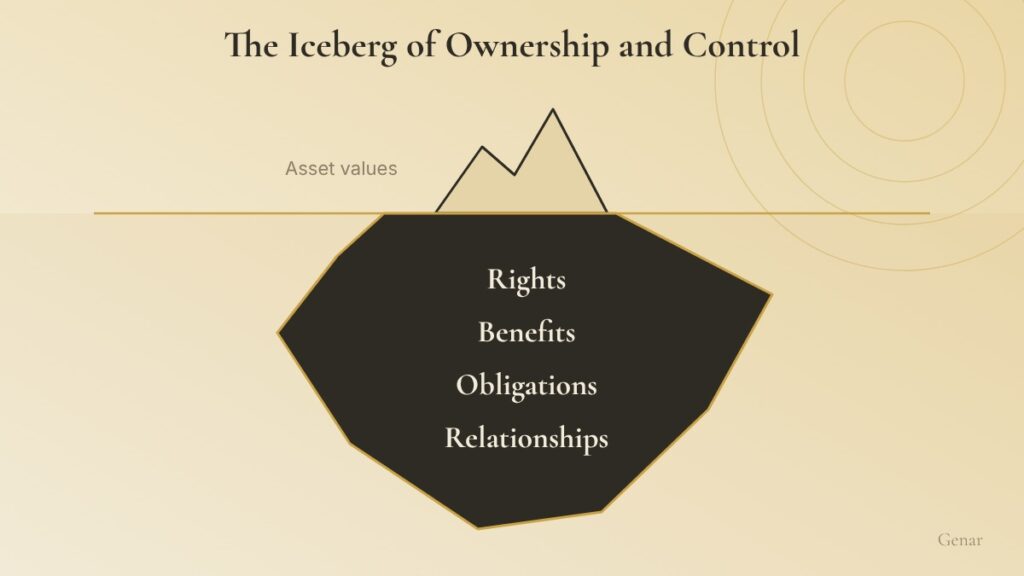
    Iceberg with a small tip above the waterline labeled asset values and a large body below it labeled rights, benefits, obligations and relationships
    Asset values are only the visible part of wealth. Beneath them lies a network of rights, interests, obligations and relationships.

    Ownership Is Not the Same as Control

    Suppose you hold 60 percent of a company. At first glance, you consider yourself the principal owner. But if the company’s important decisions depend on a board vote, agreement with another partner or contractual commitments, your ownership percentage does not necessarily translate into the same decision-making power. Continuing this line of thought, Oliver Hart and John Moore showed in a 1990 paper that when several people have a stake in a set of assets, how control rights are divided among them shapes everyone’s decisions and incentives.

    This difference matters even more in family businesses, because ownership, management and family control do not always fall precisely on one person or one group. For this reason, when examining a large fortune, the question “Who is the owner?” is sometimes incomplete. The more precise question is “Who can make the decision?” These two questions may have the same answer, but not always.

    You May Have Great Wealth and Little Authority

    Another example: a person owns several valuable properties, holds a large share of the family’s assets and, on paper, has substantial wealth. But they co-own some properties with another person, another is tied up in a financial obligation, and another cannot be sold until a specific date because of a family agreement. In this situation, the person is still wealthy, but their decision-making authority over the family wealth is not what the list of assets suggests.

    The same can happen in a family business. The owner can decide to sell the company, but selling a company is not just about receiving a sum of money. Employees, partners, a reputation built over years and even the family’s plan for intergenerational wealth transfer may all be affected. The more complex wealth becomes, the less it is simply a collection of assets. It becomes a network of rights, interests, obligations and relationships that shape one another’s decisions. For this reason, a person’s wealth may be very large, while their real authority over parts of it is far smaller than it first appears.

    When an Asset Takes On Meaning Beyond Its Price

    So far, we have discussed the legal and economic structure of ownership. But another layer matters greatly in families: the meaning an asset takes on for its owners. Imagine a house where several generations have lived. Financially, it may be just a property that could be sold and the capital moved somewhere more profitable. For the family, however, it may be part of their identity and shared history.

    Socioemotional Wealth

    In family business literature, socioemotional wealth explains this kind of nonfinancial value. Luis Gómez-Mejía and his colleagues introduced the concept in their 2007 study of family-owned olive oil mills. In a more comprehensive 2011 review, they showed that this kind of wealth can shape management decisions, governance, investment and even the family’s relationships with outside stakeholders across a wide range of family firms.

    When an asset takes on such meaning, decisions about it are no longer purely economic. Selling a company may make financial sense, yet for the family it may mean losing part of their control, identity or bond with that business. In such circumstances, the deed alone is not enough to understand who really shapes the decision. It must also be clear who sees the asset as part of the family’s identity and how that view shapes their decisions.

    Do You Own Your Wealth, or Does Your Wealth Own Your Decisions?

    This question may sound a little extreme, but it reveals a real paradox in large fortunes. Wealth is supposed to create more freedom. Yet as assets grow, so does the number of decisions you must make about them. A large business brings responsibility and decision-making. Many properties require more complex management and coordination. More partnerships open the door to more varied interests in decision-making. And a larger family brings an equal number of different, sometimes conflicting, views about the assets’ future.

    As a result, a person may have grown wealthier financially while their freedom to decide has not grown in proportion. This is one of the intriguing paradoxes of wealth architecture: the larger and more complex the assets become, the more real authority may shrink if the decision-making structure does not grow alongside them.

    What If You Could No Longer Decide Tomorrow?

    A simple thought experiment can give a clearer picture of the state of your wealth. Suppose that from tomorrow you can no longer make decisions about your assets. Your wealth does not disappear; you simply cannot decide. In this situation, the following questions arise:

    Who knows exactly what assets you have?

    Who has access to information about them?

    Who can make decisions about these assets?

    Who knows which asset matters most to you and which one could be sold if necessary?

    And if two people disagree about the future of an important asset, what happens?

    The answers to these questions may reveal the real state of your wealth more than any list of assets. Wealth is not only what you hold; it is what you must be able to make decisions about. In a healthy structure, it must be clear who will make those decisions, and on what basis, if you are unable to. This becomes doubly important when intergenerational wealth transfer comes into play.

    Legal Ownership Is Different From a Sense of Ownership

    Sometimes people feel something is “mine,” even when they are not its legal owner. In organizational psychology, this phenomenon is known as psychological ownership. In their foundational 2001 paper, Jon Pierce, Tatiana Kostova and Kurt Dirks showed that people can develop a sense of ownership toward an organization, a job, an idea or an asset, even when they do not legally own it. This feeling usually forms through three routes:

    the control a person has over the target

    the deep knowledge they have gained of it

    the part of themselves they have invested in it

    This concept is very tangible in families. A child who grew up inside their father’s company may consider it “our family’s company,” even if they hold no stake in it. A manager who has spent twenty years building a business may feel a strong sense of ownership, even if they are not its legal owner. On the other hand, a person may formally own an asset yet feel no connection to it at all.

    This difference is not just an interesting psychological point; it can shape people’s behavior. Who considers themselves responsible? Who feels committed to the asset’s future? And who, when it is transferred, feels they are losing something of “themselves”? For this reason, when it comes to family wealth, the question is not “Who owns it?” We need to understand who considers themselves responsible for it.

    From Ownership to Stewardship

    This brings us to an important concept in management: stewardship theory. Formulated by James Davis, David Schoorman and Lex Donaldson in a 1997 paper, the theory contrasts with the economic and skeptical view of the owner–manager relationship known as agency theory.

    Agency theory assumes that owners’ and managers’ interests may differ, so control and oversight mechanisms are necessary. Stewardship theory, by contrast, raises another possibility: under the right conditions, people can see themselves not merely as beneficiaries but as stewards of a purpose larger than their own personal interests.

    This concept is especially compelling for family wealth management. One person may say, “This company is mine.” Another may say, “This company is in my hands today so that I can hand it on in better health to the next person.” Both may be legal owners, but they see ownership differently. The first sees ownership mainly as a right; the second sees it alongside a responsibility. And this is exactly where the discussion of ownership connects to intergenerational wealth transfer.

    If an asset is meant to be consumed by only one generation, the question of ownership generally concerns today’s rights and interests. But if it is meant to remain for future generations, today’s owner effectively stands in the middle of a chain: they have received something and are meant to deliver something to the future. In such circumstances, ownership should not be measured only by “This is mine.” The question “What am I doing with something that is meant to reach someone else?” must also be part of it.

    Stewardship Does Not Mean Blind Trust

    There is a common mistake here. When we talk about family, legacy and responsibility, we emphasize trust and values so much that we ignore structure altogether. Yet families are not immune to disagreement, shifting interests and wrong decisions; even trustworthy people may choose differently under different circumstances.

    Stewardship theory, therefore, is not meant to replace the governance and control of family assets. On the contrary, a healthy structure must accept two realities at once: it trusts people, but it is designed so it does not depend on trust alone. This is especially important for intergenerational wealth transfer, because we cannot simply hope the next generation will be “good people.” We must make sure the structure of the wealth is clear enough that, even if there is disagreement, changing circumstances or differing views, the decision-making path remains clear. This is the point where ownership meets governance.

    Now let us return to the sentence “This wealth is mine.” Looked at more closely, it holds several different questions. Who owns this wealth? Who controls the important decisions? Who receives the benefits it generates? Who is responsible for it? Who can transfer it? Who can decide its future? And if a wrong decision is made, who is accountable?

    In a simple structure, the owner, controller and responsible party can be the same person. But as family wealth grows more complex, these roles can be divided among different people, and personal wealth gradually becomes a system.

    A Five-Minute Test for Your Wealth

    To keep this discussion from staying just an idea, try a simple exercise. Write your most important assets on a sheet of paper. You do not need to record their exact value. For each one, answer just five questions:

    Who is its legal owner?

    Who has authority over its important decisions?

    Who receives the economic benefit from it?

    If you wanted to sell or transfer it, what restrictions would apply?

    If you could no longer decide tomorrow, who could decide in your place?

    Now add one more question: are the answers to these questions clear for all your important assets? A “no” does not necessarily mean the structure of your wealth is wrong. But it points to something more important: your wealth may be more complex than people realize.

    A More Important Question for the Next Generation

    Now take this exercise one step further. Suppose your assets will not remain in your hands forever, and the next generation will receive at least part of them. The important question here is whether they know only how much they will receive or whether they also understand its structure. Do they know the answers to critical questions such as these?

    Do other people also hold rights over these assets?

    Who decides which assets can be sold and which are restricted?

    What obligations come with this wealth?

    What decisions made today will limit the next generation’s decision-making?

    Understanding these differences is vital because wealth transfer is not just a transfer of ownership. If the structure of the wealth is not clear to its current owner, transferring it to the next generation can create ambiguity instead of transferring power. In multigenerational families, that ambiguity can quickly turn into conflict. For this reason, intergenerational wealth transfer does not begin the day the deed is signed. It begins when the family clearly understands what it holds, who makes decisions about it and how this structure is meant to reach the future.
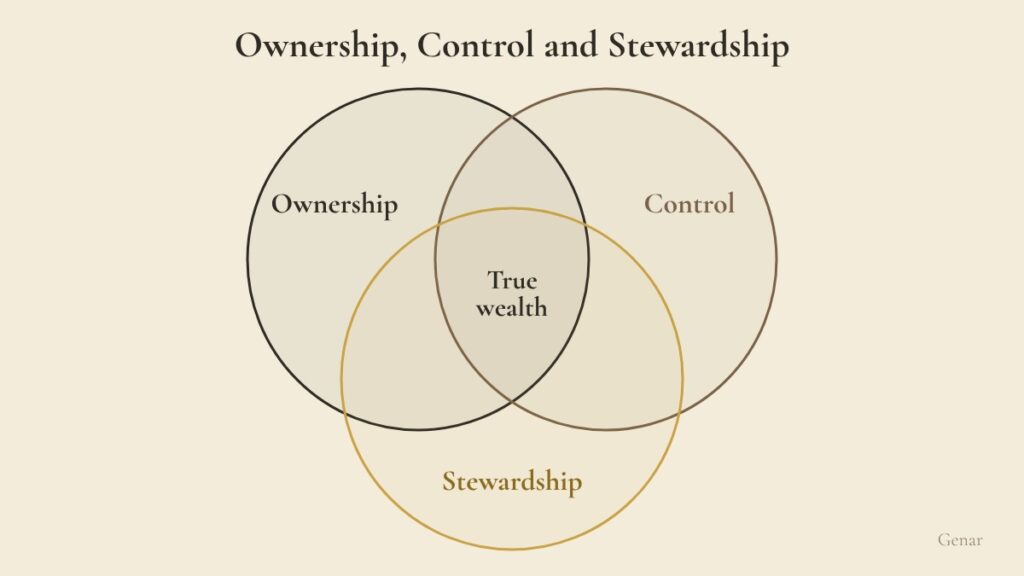
    Venn diagram of three overlapping circles labeled ownership, control and stewardship, with true wealth written where all three meet
    Ownership brings rights, control brings decision-making power and stewardship brings responsibility. True wealth sits where all three meet.

    Greater Wealth Requires More Complex Management

    Managing modest wealth, with a few accounts, a property and a business, is practically possible without much difficulty. But as wealth grows, its structure usually becomes more complex: companies, holding companies, investments, properties and assets meant to remain across generations. In these conditions, one cannot expect everything to depend on the mind and decisions of a single person, and it is precisely at this point that the question moves from asset management toward “wealth architecture.”

    Wealth Architecture and What It Means

    In one sense, wealth architecture is an easy concept to grasp. It means knowing, and making transparent, how different assets fit together, who holds what rights over them, how decisions are made, what dependencies exist among them and how the structure will continue if the current owner can no longer make decisions.

    This is where wealth-transfer planning goes beyond a simple legal or financial matter, because what is transferred is not only the value of the assets but a structure the next generation must be able to understand and steer.

    Wealth is supposed to give a person the power to choose. But if the person does not understand its structure, wealth may create unnecessary complexity instead of greater freedom. For this reason, the important question about wealth is not only how much there is. It is also “How well does the person understand it?” “How much of it can they really control?” “If circumstances change, who can decide?” and, perhaps most importantly, “If this wealth is one day transferred to the next generation, is there a structure they can understand and steer well?”

    Ownership Is Not the End of the Story

    Ownership brings rights; control gives decision-making power; and stewardship creates responsibility. These three concepts may come together in one person, but in complex structures, that is not always the case. The larger the wealth becomes, the more this difference shows, because wealth is not built for today alone. In many families, the assets one generation holds today will, tomorrow, shape the next generation’s lives and decisions.

    So the central question is not “In whose name is this wealth?” It is “Who understands it, who can steer it and who is ready to pass its responsibility on to the next generation?” Wealth in your name alone may be a valuable asset. But wealth with a clear structure, logic, and decision-making path can become more than an asset: a legacy with the value and capacity to continue for several generations.

    In the end, we arrive at the real answer to the question in this article’s title: your wealth truly belongs to you when you are not only its owner but also know what you hold, what rights you have over it, what limits there are on your authority, and how this structure is meant to reach the future. Otherwise, you may own your wealth but not yet be its architect. This is exactly where Genar’s approach to family wealth architecture takes on its meaning.

    Frequently Asked Questions

    1. What is the difference between ownership and control of an asset?

    Ownership shows who an asset legally belongs to; control shows who has the final say on key decisions about that asset.

    1. What are residual control rights?

    They are the rights to make decisions about an asset that no contract has settled in advance. Because no contract can anticipate every future situation, the asset’s owner usually retains these residual rights. This concept underpins Grossman and Hart’s property rights theory.

    1. Does socioemotional wealth relate to a family’s financial decisions?

    This concept refers to values such as family identity, control and belonging that do not appear in financial statements but still shape the family’s decisions.

    1. How is psychological ownership different from legal ownership?

    Legal ownership is a documented legal status; psychological ownership is a subjective feeling that something is “mine,” which can form independently of the deed.

    1. How does stewardship theory differ from the traditional view of management?

    Agency theory assumes that the interests of owner and manager may conflict and therefore require control and oversight. Stewardship theory also suggests that, under the right conditions, people see themselves as responsible for a purpose larger than personal gain.

  • Wealth Transfer Isn’t Just About Money

    Wealth Transfer Isn’t Just About Money

    Intergenerational wealth transfer is a sensitive subject for families, particularly wealthy ones. Yet they generally make the same mistake: they start with the money, turning first to investments, taxes, legal structures and wills. A question is asked far less often: before any money is lost, what else has already been lost?

    Ascending staircase chart of seven dark steps with gold edges and dots on a cream-to-gold gradient background
    What built the wealth does not pass to the next generation by itself. That is what is lost before the money.

    Behind every great fortune lie years of decisions, risk, and experience. The problem is that what enabled one generation to build wealth does not automatically pass to the next. A family may have designed intricate legal structures for its assets yet have no plan for preparing the people who will one day steer those assets.

    Perhaps this is exactly where the paths of two families diverge. Some fortunes erode by the second or third generation, while others remain standing even after major upheavals. The real question is not “What will reach the next generation?” It is “Has the next generation been prepared to preserve family wealth and to steer what it receives?” In this Genar article, we address that question.

    When Three Lives Rest on One Asset

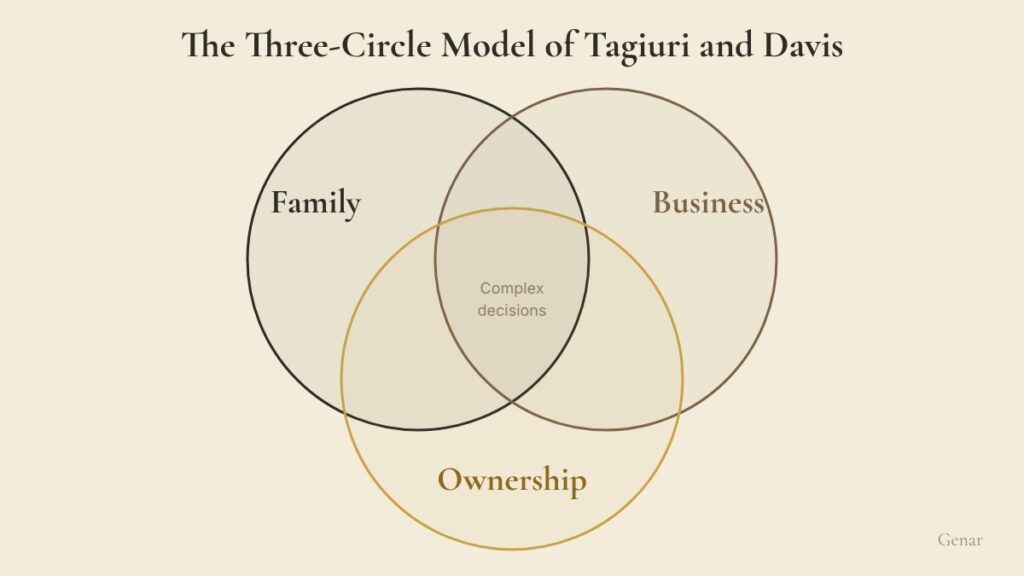
    A family that owns a family business or substantial wealth does not face a simple system. In 1978 at Harvard Business School, Renato Tagiuri and his doctoral student John Davis began developing a framework that would later become one of the best-known models in the field of family business: the Three-Circle Model of the family business.

    The framework separates three domains: family, ownership, and business. The idea first took shape in the work of two researchers in the 1970s, appeared in Davis’s doctoral dissertation in 1982, and eventually became one of the most-cited papers in the field through an article titled “Bivalent Attributes of the Family Firm” in 1996.

    The model’s core idea is simple and practical: not all family disputes are disputes between people; many are disputes between roles. A father who is the principal owner of the company says the final decision is his, while his son, the CEO, believes the authority to manage should rest with him. Both may be entirely reasonable from their perspective. The problem is not their personalities; it is a mistaken understanding of ownership and management, two concepts that must not be confused.

    As the family grows, this complexity grows with it. The number of owners increases, some enter the business, and some stay outside; under these conditions, a simple family relationship must answer emotional, ownership, and management concerns at the same time.

    Venn diagram of three overlapping circles labeled family, business and ownership, with complex decisions at the center where all three meet
    The Three-Circle Model of the family business, presented by Renato Tagiuri and John Davis

    This is exactly where structure becomes important. One person can be a family member, an owner and a manager at the same time. Another can be only a family member and owner with no role in management. A professional CEO can run the company with no family relationship at all. A sentence such as “This decision is in the family’s interest” is therefore not enough on its own. One must ask: in the interest of the family in which role, and in the interest of which generation?

    The Family Needs Governance Too

    When governance comes up, the mind usually goes to the board of directors and the bylaws. But a family that owns a business faces another question: how does the family itself make decisions?

    In the family business literature, this is called family governance. It means creating mechanisms for dialogue, decision-making, role definition and dispute management among the family, ownership and the business. The family council, the family assembly and the family charter are among the tools that more complex families use for this purpose.

    But the philosophy behind these structures matters more than their impressive titles: important issues should not be resolved for the first time in the middle of a crisis. What effect would it have on the business if one family member wanted to sell their shares? What disputes would arise if one person wanted to join the business and the others believed they lacked the necessary qualifications? These are not questions that can be answered with rules written in a moment of crisis. Good governance is not meant to eliminate disagreement; it is meant to keep disagreement from dragging the entire system down.

    But Structure Does Not Build People

    Now suppose the family has taken all these steps: it has set the rules, formed a board, refined the ownership structure and drafted the contracts with precision. All of this is necessary, but one question remains: are the people who will make decisions within this structure prepared for it?

    A structure can specify who has the right to vote, but it cannot give anyone the power of judgment. A contract can determine who owns what, but it cannot teach an heir when to hold an asset and when to change it. This is where the issue of succession shows itself.

    Being an Heir Is a Status; Becoming a Successor Is a Process

    Someone may become the heir to a large business merely by being born into a family. But no one becomes a leader by birth alone; leadership has to be built. The next generation needs the chance to make decisions, accept responsibility, face the results of its own choices, make mistakes and learn from them.

    In the family business literature, successor development is not merely the transfer of a title or shares; it is the simultaneous preparation of the family and the business to continue on their path in the next generation. An heir receives something, but a successor has acquired the ability to continue that path. The two concepts are not the same, and this is where intergenerational wealth transfer goes beyond a purely legal matter.

    Succession planning is usually a gradual path: first learning, then participating in some decisions, accepting real responsibilities, gaining greater authority at the next step and finally, if the person has shown the necessary competence, reaching a position of leadership. Successful succession does not happen on the day of the transfer; it must have been built years before.

    Financial Literacy Is Not Enough

    Suppose the next generation knows what a company is worth, what a balance sheet is and what return an asset yields. Does this knowledge mean readiness to steer wealth? Not necessarily. In the real world, important decisions do not always have a single right answer or a clear formula. What if the market crashes? What if the best economic decision conflicts with the wishes of part of the family?

    This is where financial literacy differs from competence in steering wealth. Financial literacy helps a person understand the numbers; competence helps a person exercise judgment when the answer is not known in advance.

    Wealth Is Not Always Visible in Financial Statements

    One key concept in family business research is socioemotional wealth: the values a family derives from owning and controlling the business that appear in no financial statement, such as family identity, control, belonging and the continued presence of the family.

    Luis Gómez-Mejía and his colleagues examined this concept in a well-known 2007 study of family olive oil mill owners in southern Spain. They showed that, to preserve this kind of wealth, families sometimes make decisions that look purely risky from an economic standpoint. The families chose between joining a cooperative (less business risk but loss of family control) and remaining independent (higher risk but retained control), and a large share preferred independence.

    Suppose a family receives a very large offer to sell its company. Financially, selling may be the best option, yet the family refuses. This decision is not necessarily irrational. Perhaps the company is not merely an asset to them; it is part of their identity, their name is on it and their history was formed within it. Before judging a family’s decision, ask what that family considers valuable. Sometimes the answer is not money.

    When Values Are Not Defined

    The problem begins when a family has never had a real conversation about its values. In such circumstances, in every dispute each person will hold their own definition of the “family’s best interest.” One member believes the company should be preserved because it is the family legacy. Another holds that the father was a risk-taker oriented toward growth and would have changed the company if he were alive today. Both consider themselves loyal to the legacy; only their definitions of legacy differ.

    For this reason, family values should not be merely a pretty sentence on the wall; they must show themselves in real decisions. What must never be sacrificed? If a conflict arises between preserving the legacy and building the future, which takes priority? Such conversations may seem unnecessary on calm days, but they are vital precisely for difficult days.

    Three Families, Three Different Lessons

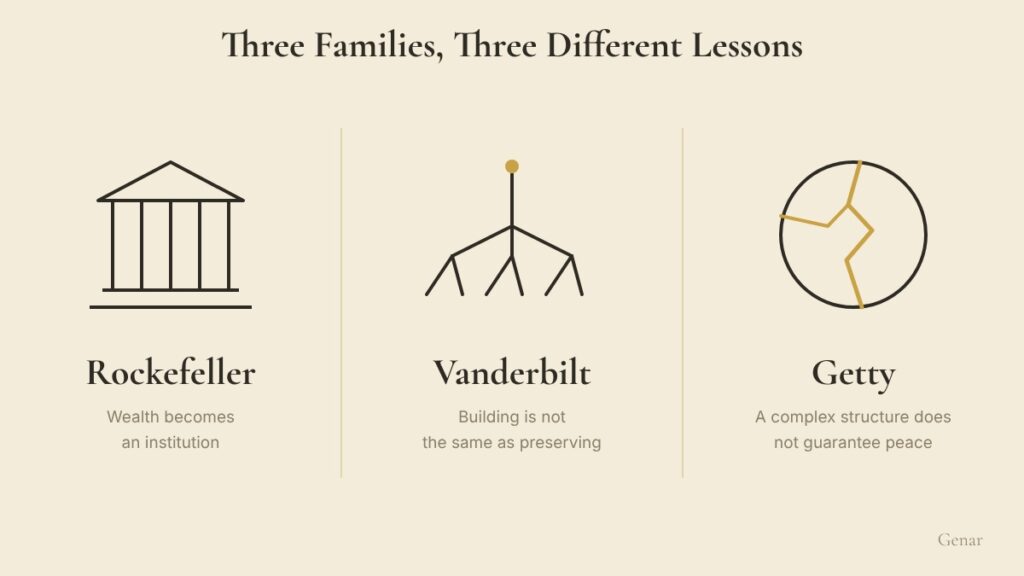
    The history of wealthy families offers no definitive formula for continuing a family business. However, three stories in particular clarify the question of intergenerational wealth transfer: the Rockefellers, the Vanderbilts and the Gettys. All three built immense fortunes, yet each carries a different lesson about how that fortune endures.

    Three line icons side by side: a columned building for Rockefeller, a branching tree for Vanderbilt and a cracked circle for Getty
    Rockefeller turned wealth into an institution. Vanderbilt showed that building and preserving are different skills. Getty showed that a complex structure does not by itself prevent disputes.

    Rockefeller: When Wealth Becomes an Institution

    John D. Rockefeller, founder of Standard Oil, built one of the largest fortunes in American history. But his story is not only about how much money remained for later generations. In 1913, the Rockefeller Foundation was established with a mission the foundation says has not changed since its first day: to promote the well-being of humanity throughout the world.

    Between 1913 and 1929, the Rockefeller family devoted substantial capital to the foundation, which, by its own figures, has distributed more than $26 billion in philanthropic capital worldwide over more than a century.

    The interesting point is that Rockefeller did not think only about “holding on to money.” Part of his wealth entered an institutional structure meant to serve a specific purpose, independent of any one person’s lifespan. The lesson of this story is not to establish a charitable foundation. The deeper lesson is that wealth can shift from a personal asset to an institution with a purpose and a time horizon independent of any one individual. The larger question than “Who owns it?” is “What is meant to remain after the owner?”

    Vanderbilt: When Building and Preserving Are Two Different Skills

    Cornelius Vanderbilt started in shipping, then moved into railroads and ultimately, by building the New York Central railroad empire, created one of the largest personal fortunes of nineteenth-century America. At his death in 1877, his estate was estimated at about $100 million, a figure that at the time exceeded the U.S. Treasury’s holdings. His son William Henry, who inherited roughly 95 percent of this fortune, not only preserved it but doubled it in less than a decade.

    The Vanderbilt story is not one of failure immediately after the founder. It is a story of serious crisis in later generations. After William Henry died, the fortune was split among his children; part of the next generation lost interest in the railroad business, and estate costs and a lavish lifestyle rose. According to historical accounts, when about 120 Vanderbilt descendants gathered in 1973 at the university Cornelius himself had founded, not one of them was a millionaire.

    Behind this lay a combination of dispersed ownership, changing economic conditions, an expensive lifestyle and the growing distance of later generations from the process that had created the wealth. The skill of building wealth is not the same as the skill of preserving it. Cornelius had to make decisions under competition and uncertainty; later generations encountered only the outcome of a path, not the difficulty of building it.

    Getty: When Great Wealth Builds a More Complex System

    1. Paul Getty built his immense fortune mainly in the oil industry. But the story of the Getty family is less about “preserving or losing money” than about the growing complexity of ownership, trust structures and family relationships between generations. The Getty family trust, formed in 1934 with about $3.3 million, became, after he died in 1976, the center of one of the most contentious family disputes in wealth history.

    According to Fortune magazine’s reporting from that era, Getty’s children and grandchildren entered a long legal battle over control of roughly $4 billion in assets and the way the trust was run. The battle even involved the rights of descendants not yet born, and it finally ended in 1985 when the trust was divided into several smaller parts among the different branches of the family.

    As the number of stakeholders grows, the question shifts from “How much money do we have?” to “Who decides, who has control and, if the family disagrees over the interpretation of ownership, who arbitrates?” The Getty story shows that a complex legal structure is not, on its own, a guarantee against disputes. Without governance, dialogue and clear rules, the structure itself can become part of the problem.

    From Three Stories to One Pattern

    The Rockefeller, Vanderbilt and Getty stories are not identical, but together they make one point clear: in each generation, wealth faces a different problem.

    The first generation is usually occupied with creating value: how does one build something that does not yet exist? The next generation must learn to steer well something it did not build itself. In later generations the question grows more complex: how does one build a shared path amid multiple owners and differing interests? For this reason, intergenerational transfer is not an “event”; each generation must prepare for its own particular problem.

    Four Layers That Must Be Built Together

    To turn this discussion into a practical framework for preparing the next generation to manage wealth, we can see it in four layers.

    1. Understanding

    The next generation must know how this wealth was built, what decisions drove it, what risks were taken and what mistakes were made. This is the difference between knowing an asset’s value and understanding its story.

    2. Competence

    Knowing is not enough; the next generation must have the chance to make decisions. The path is usually gradual: learning, participation, responsibility, authority, leadership. The goal is not for the next generation to copy the founder. The goal is for them to create value in their own time, under their own conditions.

    3. Governance

    When a family grows, the family relationship is no longer enough to resolve every issue. It must be clear who owns, who manages, who makes the final decision and how disputes are resolved.

    4. Meaning

    Ultimately, the family must know why it wants to continue this wealth. Is the goal only to preserve the value of the assets? Is creating opportunity for the next generation more important than ownership? Does “legacy” mean preserving exactly what the founder built? Or does it mean preserving the ability to create something valuable in every generation?

    These questions have no single answer, but a family that has not talked about them will likely be forced, in the hardest moment, to find answers on the spot.

    Owner or Steward?

    Another useful concept in this discussion is stewardship. Stewardship theory was proposed by James Davis, David Schoorman and Lex Donaldson in 1997 as a counterpoint to the prevailing view of the manager as a purely self-interested individual. They showed that under the right conditions, people can see themselves as serving the long-term interests of the organization and the collective, not only their personal interests.

    For wealthy families, this concept raises an intriguing question: are they the owners of these assets or their stewards for the future? These two views produce different decisions. If ownership is only an individual’s “right,” decisions are based on personal interest. But if ownership is joined by stewardship, another question enters: what does this decision mean for those who come later? Stewardship adds a time horizon to the decision without depriving the owner of the freedom to choose.

    A Simple Test for Families

    Suppose you own a business or a substantial part of the family wealth. Ask yourself these five questions:

    Does the next generation know how the family wealth was built?

    Has it ever had the chance to make real decisions and experience their results?

    Can it distinguish among the roles of “family member,” “owner” and “manager”?

    Has our family discussed possible future disputes before they occur?

    If the next generation has to change part of what we have built, does it know what must be preserved and what can be changed?

    If the answer to some of these questions is “no,” it does not necessarily mean failure. But it is an important sign that part of the transfer architecture has not yet been built.

    What Intergenerational Wealth Transfer Must Carry

    The question of wealth transfer cannot be solved with a document or a legal structure alone. These tools are necessary, but they are only part of the solution. Alongside assets, other things must also be transferred: knowledge for understanding, competence for making decisions, governance for managing complexity, and meaning for knowing why this path should continue.

    At first glance, the question is what intergenerational wealth transfer should transfer. At second glance, the question is what system must be built so that the next generation can make sound decisions with what it receives. These two questions are not alike, and this very difference separates one family’s path from another’s. In Genar’s articles on family and wealth, we have explored this subject from other angles as well.

    From Wealth Transfer to an Architecture of Continuity

    A family may use the best lawyers, financial advisors, and investment managers, benefit from a precise ownership structure, and have all contracts properly concluded. But if the generation that will make the decisions has not been prepared for that responsibility, part of the problem remains unresolved. On the other hand, educating one generation is not enough on its own either. If roles are unclear and family members have not discussed shared values and the future, even capable people may fail to be productive within a dysfunctional system and may fail to chart a sound path forward.

    Continuity of a family business is therefore not the product of a single element; people, structure and meaning must be designed together. This is where wealth transfer shifts from a legal event to an intergenerational project. The question for a family thinking about the future is not only “What are we leaving to our children?” The harder question is this: if everything is placed in their hands tomorrow, will they be prepared for the decisions they must make after us?

    A contract can transfer ownership, a structure can regulate power, capital can create opportunity, but competence must be built, governance must be designed and legacy must be given meaning.

    Perhaps the most lasting thing one generation can leave the next is not the wealth itself but the ability to build a future in which that wealth can continue to create value. This is the point where Genar’s approach to preparing the next generation begins.