Tag: Family Business

هر مقاله‌ای که موضوعش شرکتی در مالکیت یک خانواده است

  • Preparing a Successor in a Family Business

    Preparing a Successor in a Family Business

    Preparing a successor in a family business usually begins with one important question: “Which of the children should take over the business?” But look at the history of one of the few independent whisky distilleries left, and a different issue emerges. This family business asked another, more important question: “Regardless of who succeeds, where and when should the successor’s experience take shape?”

    Speyside, in the Scottish Highlands, is home to more than fifty whisky distilleries. Many of them now belong to large international companies such as Diageo and Pernod Ricard, both listed on the stock exchange. But among the green fields beside Ben Rinnes, one distillery is still run the way earlier generations did: one family owns it, with no outside shareholders and no parent company.

    The company is called Glenfarclas, and the Grant family has run it for more than a century and a half. What makes this family interesting is something that has passed from one generation to the next without ever being written down. Before taking their seat at the family business, Glenfarclas successors went through a remarkable kind of training, one that looks more like a fairly risky adventure. Sometimes they chose this training; sometimes they learned from a bitter failure. More striking still, each time their industry fell into a downturn, they did not narrow their horizons; they took bolder and sometimes stranger steps. In this «Genar» article, we look at Glenfarclas, the Grant family and the path they chose.

    The main source for the history in this article is Glenfarclas: An Independent Distillery by Ian Buxton, a historian of the whisky industry who wrote the book to record the family’s and the distillery’s history.

    The First and Second Generations: No Time to Prepare

    John Grant (1805–1889) was a cattle breeder whose only contact with whisky was drinking it. In 1865, he bought Rechlerich farm, together with the distillery beside it, licensed since 1836 by the previous tenant, Robert Hay, for £511 and 19 shillings, a large sum at the time, equal to 2,560 days’ wages for a skilled worker. Even so, he had nothing to do with making whisky. He focused on cattle breeding and, for extra income, leased the distillery to a local man who knew the distilling trade. That man was John Smith, who later founded the Cragganmore distillery. The choice was no accident: Smith had previously managed the Macallan, Glenlivet and Clydesdale (in Wishaw) distilleries and was an experienced distiller. According to the family, he was also a distant relative of John Grant.

    In 1870, Smith built his own distillery and parted ways with the Grants. In his place, John Grant brought in his son George, who had married Elsie Gordon that same year. George had five children, including two sons named John and George, names that recur in later generations and make the family tree somewhat hard for today’s reader to follow.

    George Grant (1830–1890) inherited the farm and distillery in 1889, but died just a year later. His widow, Elsie, inherited the business and the farm and handed its management to her two eldest sons. No one had much time to prepare.

    The Third Generation: From a Major Failure to an Established Tradition

    In the late 1890s, John (1873–1949) and George (1874–1949) sold half the company to Pattisons of Leith to finance expansion. The Pattison brothers were originally dairy merchants in Edinburgh who saw a big opportunity in the growing whisky industry. They founded their joint company with the Grants in 1896 and, with expensive advertising and big promises, attracted substantial capital from investors. The Pattison brothers became the industry’s stars, but the empire they built was nothing more than a large-scale fraud. The brothers went to prison, and their company went bankrupt. Their collapse set off a chain-reaction downturn across the entire Scotch whisky industry.

    Stacked wooden whisky casks in a pyramid, some with blue or yellow heads, on snowy ground
    The downturn after the Pattison collapse forced the Grants to sell part of their stock cheaply and repay the debt within eight years.

    The downturn forced the Grant brothers to save the business by selling part of their whisky stock at a very low price and to cover the remaining losses with a loan from the Caledonian Bank, secured against the farm and its stocks. The family repaid the entire debt within eight years.

    The experience cost the family dearly, financially and psychologically. However, it also taught a lasting lesson: the family would never again so easily share full ownership of its business with anyone outside the family.

    The Fourth Generation: A Collection Born of a Threat

    George, the third-generation George’s son, remained chairman for 52 years, until he died in 2002. He turned one of the company’s greatest threats into an even greater opportunity. In 1968, the Distillers Company (later part of Diageo) sent him a letter stating that it intended to stop using Glenfarclas output in its blends the following year. Although the threat was never fully carried out and purchases continued the next year, it prompted George to make a decision that set Glenfarclas on a different path. George did not want his company to depend so heavily on one large customer, so he set aside a larger share of production to bottle and sell directly.

    Years later, this decision became a collection of 43 consecutive vintages from 1952 to 1994. In this business, a “vintage” means the contents of a specific cask from a specific year of distillation, not a blend of several casks like most whiskies on the market. Having a sound vintage from every consecutive year means an unbroken chain, with no gap in the stock.

    Rather than selling it to the market, the family deliberately set this stock aside to bottle and release one day. In 2007, the plan came to fruition: the 43 vintages were released under a single name, the Family Casks collection. Each bottle came from a specific, individually numbered cask, at natural cask strength and without dilution. As a result, each vintage had a very limited run.

    Almost no other distillery in Scotland could have repeated this, because few distilleries, especially after the 1980s downturn, held such an unbroken stock. Glenfarclas could release all 43 years only because, in earlier years, it gradually set aside some of its output without knowing it would one day form such a collection.

    Dark warehouse with rows of wooden casks on both sides of an aisle, sunlight from high windows and the years 1978 and 1985 marked on the casks
    For years, Glenfarclas set aside part of its output, not knowing it was building a 43-year chain that would become the Family Casks collection.

    Over time, some years (such as 1979) were re-released several times in new editions, and by 2017 the collection had passed 380 bottlings. Its market value has also become clear: a complete set of 43 bottles was estimated at £140,000 to £180,000 at a Bonhams auction. What began in the 1960s as a defensive reaction became, six decades later, one of the most valuable Scotch whisky collections in history.

    The Fifth and Sixth Generations: “Better to Make Your Mistakes Somewhere Else”

    Before joining the family business, the son of the fourth-generation George worked for three years at a rival company, Teacher’s. Teacher’s was one of the best-known Scotch blended whisky brands, a business where, unlike Glenfarclas, bottle sales and branding had been central from the start rather than a side activity alongside bulk sales to blenders.

    In keeping with family tradition, this son was also named John. When the fifth-generation John returned, he asked his father what he should do next. His father asked him where Teacher’s made its money, and John replied that it came from selling bottles of Teacher’s. That conversation sparked the shift of the 1970s: a greater focus on bottle sales instead of relying solely on bulk sales.

    The conversation did not happen in a vacuum. A few years earlier, his father, George, had risked losing one of the family’s most important contracts with a large customer, the same threat reflected in the Distillers Company’s 1968 letter. When John returned from Teacher’s, his father had concluded that the company could no longer rely on bulk sales alone. John’s sales experience turned that defensive, emergency decision into a clear career path. He spent the next few years in sales and, in 1979, at 28, became managing director. From then on, Glenfarclas began building a network of independent importers and distributors in different countries, an approach it still uses today.

    Seeing Opportunity in the Middle of a Downturn

    In the 1980s, the whisky industry went through another downturn. While many distilleries closed, Glenfarclas also reduced output, but it kept producing and laying down stock. When the downturn ended, its aged stock was ready: the same 1968 pattern, repeated in another generation. For his son George, John turned his own experience into a clear principle, one George calls an “unwritten rule”: “Better to make your mistakes somewhere else.”

    George’s path shows that this was more than a slogan:

    An apprenticeship at Muntons, a malting company, before setting foot in any distillery.

    A year at Inver House and, in all, work at four different distilleries, from mashing and distilling to warehouse work.

    A period in Bordeaux, learning about wine.

    Two years in sales in Hong Kong, mainly wine, vodka and gin, not his own family’s whisky.

    A return to Glenfarclas in 2000 and a seat on the board in 2013, after global sales grew by more than 75 percent over four years.
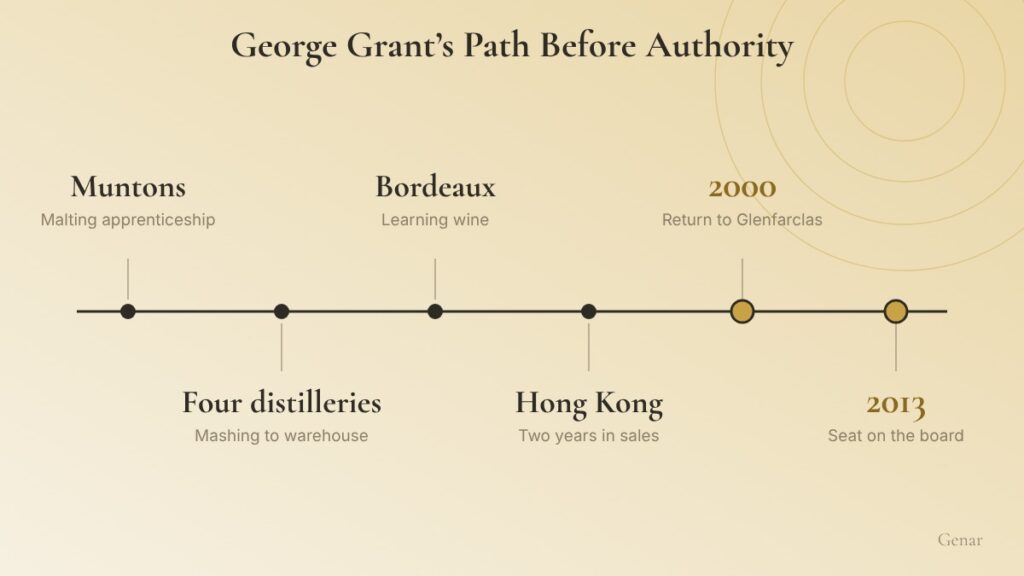
    Six-step timeline: apprenticeship at Muntons, work at four distilleries, studying wine in Bordeaux, two years in sales in Hong Kong, return to Glenfarclas in 2000 and a seat on the board in 2013
    Before deciding anything for the family business, George Grant practiced deciding elsewhere, and made his mistakes there.

    This path was no accident. Before he was ever expected to make decisions about the family business, George had to practice decision-making elsewhere, make his mistakes there and measure himself against a standard other than his family’s. More importantly, he gained this experience outside the family business while Asia was in the grip of a financial crisis, not during a calm, predictable period. Today, Glenfarclas exports to more than 100 countries.

    One Pattern, Many Behaviors

    In 2025, another severe downturn awaited the whisky industry worldwide; yet once again, Glenfarclas took a different path and secured permission to build six new warehouses. Its distillery manager, Callum Fraser, said of the decision: “It may seem strange to be building more warehouses.” The family spends about £3 million a year on casks alone; with this investment, it is not limiting its horizon to next season but looking decades ahead.

    In the Grants’ history, the same logic has repeated several times. When dependence on one customer became a threat, they built a whisky collection. When the market moved into a downturn, they saw future capacity. And when the next generation was due to take over the business, they sent it out of the house. These decisions follow a single pattern and lead to important, complementary results: the family not only tried to preserve its assets; it also tried to build the next generation’s capacity to make decisions.

    In 1980, the same logic showed up in another form. Glenfarclas tried heating one of its stills with steam coils, a cheaper method than direct firing. But according to John Grant, the spirit changed completely: “All the character had gone, and it was very bland.” After about a week, they stopped the trial, and the distillery returned to the more expensive direct firing it still uses today.

    Preparing a Successor Is More Than Naming an Heir

    Had George joined Glenfarclas directly, he would have been an heir from day one. But his path through Muntons, four distilleries, Bordeaux and Hong Kong gave him something else: experience gained before authority.

    Stewardship theory relates to this discussion from another angle. In 1997, Davis, Schoorman and Donaldson showed that, contrary to the prevailing view of the manager as a purely self-interested individual, people under the right conditions can see themselves not merely as owners of personal gain but as stewards of a larger purpose. More recent research has examined the role of outside experience more directly. A study by Kustec, Østergaard, and Sasson (2025 version) shows that successors with outside work experience perform roughly on par with professional, non-family CEOs after succession, while successors who grew up only inside the firm show no improvement in performance. Ge and Campopiano (2022), in a review of research on knowledge management in succession, also emphasize the importance of building and transferring the knowledge needed to lead a family firm successfully.

    The family has never said that George’s outside experience was designed specifically to avoid repeating earlier generations’ mistakes; that is our reading. Dig a little deeper, though, and an interesting conclusion emerges: if a successor’s first serious mistake happens inside the family business, the successor does not pay the cost alone; it may fall on the family, the employees, the capital and even control of ownership. If part of that learning takes place elsewhere, the family can still benefit from the result without the mistakes directly affecting its financial legacy.

    Day-to-day production management today rests with Callum Fraser, a specialist from outside the Grant family who was hired in 2012 and named Master Distiller/Master Blender of the Year at the Icons of Whisky Scotland awards in 2026.

    This points to something interesting about Glenfarclas: the family’s financial independence does not mean complete managerial exclusivity. The family keeps ownership and strategic direction and brings in operational expertise from outside, the same distinction that Genar’s article «Is Your Wealth Really Yours?» explores: how you can own something without being the only one who decides about it.

    What We Still Do Not Know

    We know nothing about the fourth generation’s path before he took charge. The company’s official financial statements are not publicly available; the £3 million figure is only annual cask spending, not total revenue.

    Nothing is certain about the seventh generation either. George has two daughters. We do not know whether the “work outside” rule will apply to the next generation or whether someone from that generation will join the business directly.

    A Lesson for Facing a Downturn

    The Grants’ pattern follows a clear rule: in a downturn or under threat, buy the resources competitors let go of.

    In 1968 and in the 1980s, when many players in the industry faced a serious threat and scaled back, Glenfarclas saw the opportunity and did not stop producing or laying down stock. In a downturn, the opportunity does not always lie in an asset becoming cheaper; sometimes it lies in fewer people still being willing to spend on the future.

    This is the question any business facing high inflation and political uncertainty can ask today: in this downturn, which resource (property, equipment, skilled staff, even a rival brand leaving the field) is available below its real value because of other people’s fear?

    The second point, however, is more practical: bring your successor into the field during this very period of uncertainty, not after it. George Grant was not sent to Hong Kong and Bordeaux during a period of stability; he went to Hong Kong while a financial crisis gripped Asia. Experience gained under constraint is not the same as experience built in stable conditions.

    Three Actions for Today

    Under current conditions, as a business owner, you can take a few essential steps:

    Make a list of the resources weaker competitors are abandoning in this downturn; you do not need to buy them right away, but you do need to recognize the opportunity.

    If you have a successor in preparation, turn this downturn into their training ground rather than an excuse to postpone it. Give them a real decision, with a limited budget and in uncertain conditions, whose outcome (profit or loss) is theirs.

    Make one expense this year that would otherwise be justified “next season,” precisely when everyone else is waiting for conditions to change.

    By taking these actions, you will arrive at the same question the Grant family pursued over several generations: “If you expect your successor to make their first serious mistake this year, where would you rather it happen? Inside your business, or somewhere the cost of that mistake falls on them, while the family gains only the result and the lesson at no cost?”

    A Mental Exercise: Where Should the Next Generation Gain Experience?

    Take a pen and paper, not to find the right answer, but only to sharpen the questions:

    If your successor joined the business tomorrow and made a major mistake, what would that mistake cost the family?

    Which skill can you not teach them inside your own business?

    Where could they practice that skill with real responsibility, somewhere their mistakes would cost the family less?

    Under today’s uncertainty, which experience have you postponed with the excuse that “now is not the right time”?

    If the next generation is not meant to be owners only, what must they experience before receiving authority to become successors?

    Conclusion

    The Grants did not preserve their business’s independence simply by holding on to its ownership. They built part of that independence through decisions that might not have seemed sensible in the short term: stock they did not yet need, investment during a market pullback, and sending the next generation into environments where their family name could not stand in for experience.

    They did not take risk out of the house to stay safe; they accepted it elsewhere, at a lower cost, so the new generation would be ready when they returned home. Experience gained through real responsibility is exactly what the article «The Mind Builds Wealth, Not Money» Alone describes as “financial mental architecture”: a child who is never allowed to make mistakes has never practiced making decisions.

  • Does Your Wealth Really Belong to You?

    Does Your Wealth Really Belong to You?


    Ownership and control of wealth are two separate concepts that people usually treat as one. Ask someone, “How much wealth do you have?” and they usually answer with a number: the value of a company, the price of properties, shares, investments. But change the question slightly, and the answer is no longer so simple. The new question is: how much of this wealth is actually under the person’s authority?

    A person may own a company, yet partners or the board of directors make the important decisions. Another may own several properties, yet contracts, debt, or family commitments limit their freedom. A single person may even hold full legal authority over an asset, yet every decision they make about it also affects the future of family members or the next generation.

    So perhaps “having” wealth is not the end of the story; it raises a more important question: when we talk about having wealth, what exactly do we mean? In this Genar article, we explore that question.

    Ownership Is Not Just a Word

    In everyday life, ownership seems simple: this house or this company belongs to one person. In economics and law, however, ownership means something more precise. One of the most important perspectives in modern economics is property rights theory.

    In their well-known 1986 paper, Sanford Grossman and Oliver Hart showed that contracts cannot anticipate every future situation or every possible use of an asset. For this reason, part of the right to make decisions about an asset inevitably remains with the owner, what economic literature calls residual control rights.

    This perspective complicates our simple definition of ownership. When someone says “This asset is mine,” they should be able to state precisely what rights they hold. Can they use it? Can they receive the benefits it generates? Can they decide how it is used? Can they sell or transfer it? And in situations the contract does not mention, who has the right to decide?

    Ownership does not necessarily mean that one person can make any decision they want under any circumstances. The extent of their decision-making power depends on the legal structure around that asset. This is where the difference between ownership and control of an asset becomes clear.

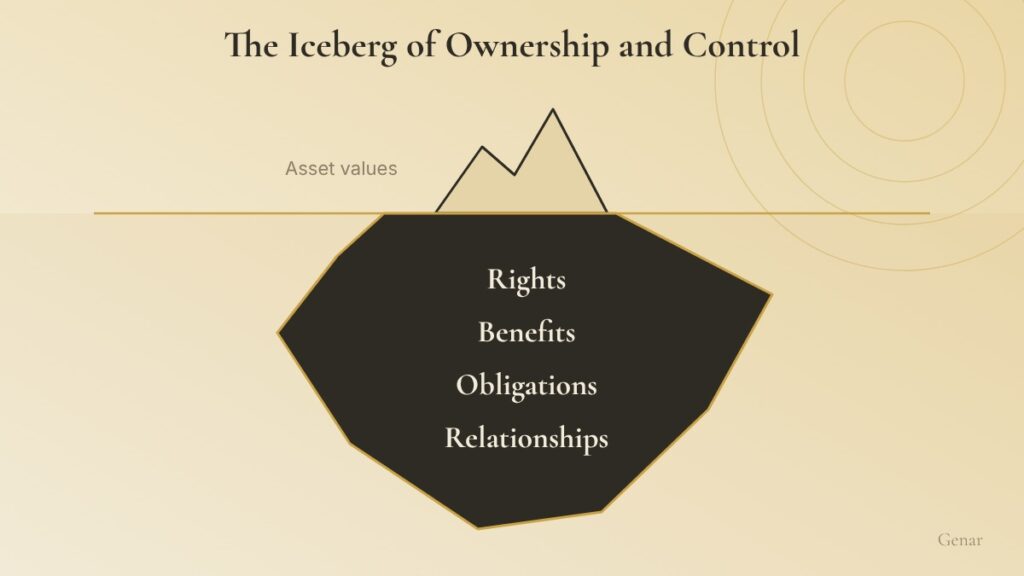
    Iceberg with a small tip above the waterline labeled asset values and a large body below it labeled rights, benefits, obligations and relationships
    Asset values are only the visible part of wealth. Beneath them lies a network of rights, interests, obligations and relationships.

    Ownership Is Not the Same as Control

    Suppose you hold 60 percent of a company. At first glance, you consider yourself the principal owner. But if the company’s important decisions depend on a board vote, agreement with another partner or contractual commitments, your ownership percentage does not necessarily translate into the same decision-making power. Continuing this line of thought, Oliver Hart and John Moore showed in a 1990 paper that when several people have a stake in a set of assets, how control rights are divided among them shapes everyone’s decisions and incentives.

    This difference matters even more in family businesses, because ownership, management and family control do not always fall precisely on one person or one group. For this reason, when examining a large fortune, the question “Who is the owner?” is sometimes incomplete. The more precise question is “Who can make the decision?” These two questions may have the same answer, but not always.

    You May Have Great Wealth and Little Authority

    Another example: a person owns several valuable properties, holds a large share of the family’s assets and, on paper, has substantial wealth. But they co-own some properties with another person, another is tied up in a financial obligation, and another cannot be sold until a specific date because of a family agreement. In this situation, the person is still wealthy, but their decision-making authority over the family wealth is not what the list of assets suggests.

    The same can happen in a family business. The owner can decide to sell the company, but selling a company is not just about receiving a sum of money. Employees, partners, a reputation built over years and even the family’s plan for intergenerational wealth transfer may all be affected. The more complex wealth becomes, the less it is simply a collection of assets. It becomes a network of rights, interests, obligations and relationships that shape one another’s decisions. For this reason, a person’s wealth may be very large, while their real authority over parts of it is far smaller than it first appears.

    When an Asset Takes On Meaning Beyond Its Price

    So far, we have discussed the legal and economic structure of ownership. But another layer matters greatly in families: the meaning an asset takes on for its owners. Imagine a house where several generations have lived. Financially, it may be just a property that could be sold and the capital moved somewhere more profitable. For the family, however, it may be part of their identity and shared history.

    Socioemotional Wealth

    In family business literature, socioemotional wealth explains this kind of nonfinancial value. Luis Gómez-Mejía and his colleagues introduced the concept in their 2007 study of family-owned olive oil mills. In a more comprehensive 2011 review, they showed that this kind of wealth can shape management decisions, governance, investment and even the family’s relationships with outside stakeholders across a wide range of family firms.

    When an asset takes on such meaning, decisions about it are no longer purely economic. Selling a company may make financial sense, yet for the family it may mean losing part of their control, identity or bond with that business. In such circumstances, the deed alone is not enough to understand who really shapes the decision. It must also be clear who sees the asset as part of the family’s identity and how that view shapes their decisions.

    Do You Own Your Wealth, or Does Your Wealth Own Your Decisions?

    This question may sound a little extreme, but it reveals a real paradox in large fortunes. Wealth is supposed to create more freedom. Yet as assets grow, so does the number of decisions you must make about them. A large business brings responsibility and decision-making. Many properties require more complex management and coordination. More partnerships open the door to more varied interests in decision-making. And a larger family brings an equal number of different, sometimes conflicting, views about the assets’ future.

    As a result, a person may have grown wealthier financially while their freedom to decide has not grown in proportion. This is one of the intriguing paradoxes of wealth architecture: the larger and more complex the assets become, the more real authority may shrink if the decision-making structure does not grow alongside them.

    What If You Could No Longer Decide Tomorrow?

    A simple thought experiment can give a clearer picture of the state of your wealth. Suppose that from tomorrow you can no longer make decisions about your assets. Your wealth does not disappear; you simply cannot decide. In this situation, the following questions arise:

    Who knows exactly what assets you have?

    Who has access to information about them?

    Who can make decisions about these assets?

    Who knows which asset matters most to you and which one could be sold if necessary?

    And if two people disagree about the future of an important asset, what happens?

    The answers to these questions may reveal the real state of your wealth more than any list of assets. Wealth is not only what you hold; it is what you must be able to make decisions about. In a healthy structure, it must be clear who will make those decisions, and on what basis, if you are unable to. This becomes doubly important when intergenerational wealth transfer comes into play.

    Legal Ownership Is Different From a Sense of Ownership

    Sometimes people feel something is “mine,” even when they are not its legal owner. In organizational psychology, this phenomenon is known as psychological ownership. In their foundational 2001 paper, Jon Pierce, Tatiana Kostova and Kurt Dirks showed that people can develop a sense of ownership toward an organization, a job, an idea or an asset, even when they do not legally own it. This feeling usually forms through three routes:

    the control a person has over the target

    the deep knowledge they have gained of it

    the part of themselves they have invested in it

    This concept is very tangible in families. A child who grew up inside their father’s company may consider it “our family’s company,” even if they hold no stake in it. A manager who has spent twenty years building a business may feel a strong sense of ownership, even if they are not its legal owner. On the other hand, a person may formally own an asset yet feel no connection to it at all.

    This difference is not just an interesting psychological point; it can shape people’s behavior. Who considers themselves responsible? Who feels committed to the asset’s future? And who, when it is transferred, feels they are losing something of “themselves”? For this reason, when it comes to family wealth, the question is not “Who owns it?” We need to understand who considers themselves responsible for it.

    From Ownership to Stewardship

    This brings us to an important concept in management: stewardship theory. Formulated by James Davis, David Schoorman and Lex Donaldson in a 1997 paper, the theory contrasts with the economic and skeptical view of the owner–manager relationship known as agency theory.

    Agency theory assumes that owners’ and managers’ interests may differ, so control and oversight mechanisms are necessary. Stewardship theory, by contrast, raises another possibility: under the right conditions, people can see themselves not merely as beneficiaries but as stewards of a purpose larger than their own personal interests.

    This concept is especially compelling for family wealth management. One person may say, “This company is mine.” Another may say, “This company is in my hands today so that I can hand it on in better health to the next person.” Both may be legal owners, but they see ownership differently. The first sees ownership mainly as a right; the second sees it alongside a responsibility. And this is exactly where the discussion of ownership connects to intergenerational wealth transfer.

    If an asset is meant to be consumed by only one generation, the question of ownership generally concerns today’s rights and interests. But if it is meant to remain for future generations, today’s owner effectively stands in the middle of a chain: they have received something and are meant to deliver something to the future. In such circumstances, ownership should not be measured only by “This is mine.” The question “What am I doing with something that is meant to reach someone else?” must also be part of it.

    Stewardship Does Not Mean Blind Trust

    There is a common mistake here. When we talk about family, legacy and responsibility, we emphasize trust and values so much that we ignore structure altogether. Yet families are not immune to disagreement, shifting interests and wrong decisions; even trustworthy people may choose differently under different circumstances.

    Stewardship theory, therefore, is not meant to replace the governance and control of family assets. On the contrary, a healthy structure must accept two realities at once: it trusts people, but it is designed so it does not depend on trust alone. This is especially important for intergenerational wealth transfer, because we cannot simply hope the next generation will be “good people.” We must make sure the structure of the wealth is clear enough that, even if there is disagreement, changing circumstances or differing views, the decision-making path remains clear. This is the point where ownership meets governance.

    Now let us return to the sentence “This wealth is mine.” Looked at more closely, it holds several different questions. Who owns this wealth? Who controls the important decisions? Who receives the benefits it generates? Who is responsible for it? Who can transfer it? Who can decide its future? And if a wrong decision is made, who is accountable?

    In a simple structure, the owner, controller and responsible party can be the same person. But as family wealth grows more complex, these roles can be divided among different people, and personal wealth gradually becomes a system.

    A Five-Minute Test for Your Wealth

    To keep this discussion from staying just an idea, try a simple exercise. Write your most important assets on a sheet of paper. You do not need to record their exact value. For each one, answer just five questions:

    Who is its legal owner?

    Who has authority over its important decisions?

    Who receives the economic benefit from it?

    If you wanted to sell or transfer it, what restrictions would apply?

    If you could no longer decide tomorrow, who could decide in your place?

    Now add one more question: are the answers to these questions clear for all your important assets? A “no” does not necessarily mean the structure of your wealth is wrong. But it points to something more important: your wealth may be more complex than people realize.

    A More Important Question for the Next Generation

    Now take this exercise one step further. Suppose your assets will not remain in your hands forever, and the next generation will receive at least part of them. The important question here is whether they know only how much they will receive or whether they also understand its structure. Do they know the answers to critical questions such as these?

    Do other people also hold rights over these assets?

    Who decides which assets can be sold and which are restricted?

    What obligations come with this wealth?

    What decisions made today will limit the next generation’s decision-making?

    Understanding these differences is vital because wealth transfer is not just a transfer of ownership. If the structure of the wealth is not clear to its current owner, transferring it to the next generation can create ambiguity instead of transferring power. In multigenerational families, that ambiguity can quickly turn into conflict. For this reason, intergenerational wealth transfer does not begin the day the deed is signed. It begins when the family clearly understands what it holds, who makes decisions about it and how this structure is meant to reach the future.

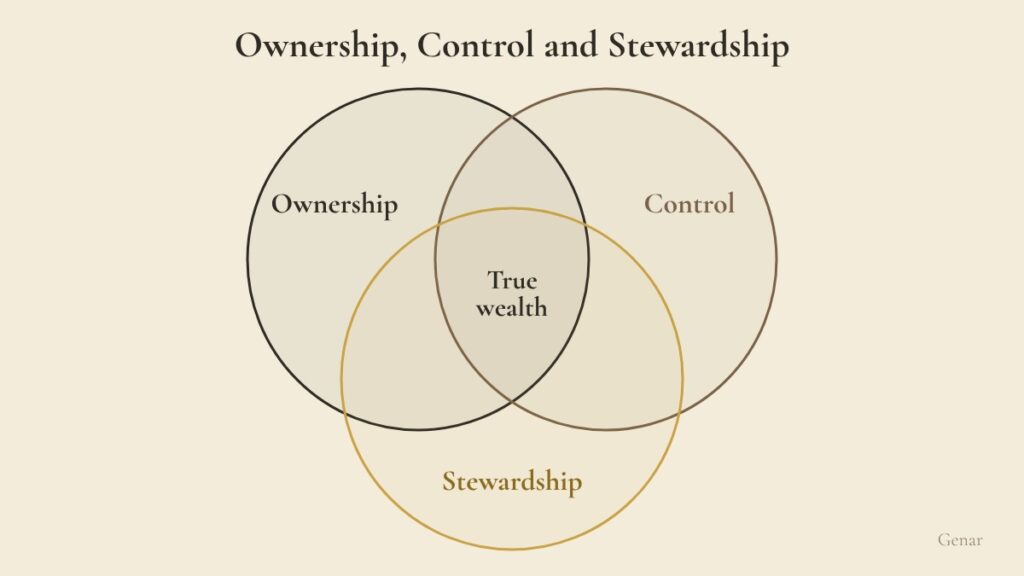
    Venn diagram of three overlapping circles labeled ownership, control and stewardship, with true wealth written where all three meet
    Ownership brings rights, control brings decision-making power and stewardship brings responsibility. True wealth sits where all three meet.

    Greater Wealth Requires More Complex Management

    Managing modest wealth, with a few accounts, a property and a business, is practically possible without much difficulty. But as wealth grows, its structure usually becomes more complex: companies, holding companies, investments, properties and assets meant to remain across generations. In these conditions, one cannot expect everything to depend on the mind and decisions of a single person, and it is precisely at this point that the question moves from asset management toward “wealth architecture.”

    Wealth Architecture and What It Means

    In one sense, wealth architecture is an easy concept to grasp. It means knowing, and making transparent, how different assets fit together, who holds what rights over them, how decisions are made, what dependencies exist among them and how the structure will continue if the current owner can no longer make decisions.

    This is where wealth-transfer planning goes beyond a simple legal or financial matter, because what is transferred is not only the value of the assets but a structure the next generation must be able to understand and steer.

    Wealth is supposed to give a person the power to choose. But if the person does not understand its structure, wealth may create unnecessary complexity instead of greater freedom. For this reason, the important question about wealth is not only how much there is. It is also “How well does the person understand it?” “How much of it can they really control?” “If circumstances change, who can decide?” and, perhaps most importantly, “If this wealth is one day transferred to the next generation, is there a structure they can understand and steer well?”

    Ownership Is Not the End of the Story

    Ownership brings rights; control gives decision-making power; and stewardship creates responsibility. These three concepts may come together in one person, but in complex structures, that is not always the case. The larger the wealth becomes, the more this difference shows, because wealth is not built for today alone. In many families, the assets one generation holds today will, tomorrow, shape the next generation’s lives and decisions.

    So the central question is not “In whose name is this wealth?” It is “Who understands it, who can steer it and who is ready to pass its responsibility on to the next generation?” Wealth in your name alone may be a valuable asset. But wealth with a clear structure, logic, and decision-making path can become more than an asset: a legacy with the value and capacity to continue for several generations.

    In the end, we arrive at the real answer to the question in this article’s title: your wealth truly belongs to you when you are not only its owner but also know what you hold, what rights you have over it, what limits there are on your authority, and how this structure is meant to reach the future. Otherwise, you may own your wealth but not yet be its architect. This is exactly where Genar’s approach to family wealth architecture takes on its meaning.

    Frequently Asked Questions

    1. What is the difference between ownership and control of an asset?

    Ownership shows who an asset legally belongs to; control shows who has the final say on key decisions about that asset.

    1. What are residual control rights?

    They are the rights to make decisions about an asset that no contract has settled in advance. Because no contract can anticipate every future situation, the asset’s owner usually retains these residual rights. This concept underpins Grossman and Hart’s property rights theory.

    1. Does socioemotional wealth relate to a family’s financial decisions?

    This concept refers to values such as family identity, control and belonging that do not appear in financial statements but still shape the family’s decisions.

    1. How is psychological ownership different from legal ownership?

    Legal ownership is a documented legal status; psychological ownership is a subjective feeling that something is “mine,” which can form independently of the deed.

    1. How does stewardship theory differ from the traditional view of management?

    Agency theory assumes that the interests of owner and manager may conflict and therefore require control and oversight. Stewardship theory also suggests that, under the right conditions, people see themselves as responsible for a purpose larger than personal gain.